Prosperity AI · Insight
From 100 to 1,000 Business Reviews: Building an AI Growth Intelligence System
From 100 to 1,000 Business Reviews: Building an AI Growth Intelligence System
Why the future of business intelligence depends on learning which decisions produce better outcomes — and under which conditions.
By Prosperity AI Research Team
October 21, 2026
The Next Frontier of AI Is Not More Analysis. It’s Better Decisions.
Artificial intelligence is making business analysis faster, more accessible, and increasingly affordable.
But generating more reports does not automatically create better business outcomes.
The real opportunity is to build intelligence that improves with every analysis, every validated decision, and every measured result.
At Prosperity AI, we are working toward that objective.
Following our first 100 B2B SaaS Business Reviews in the San Francisco Bay Area, our strategic research has continued to expand.
The ambition is not simply to analyze 1,000 companies. It is to build a proprietary intelligence system that learns which strategic decisions generate better economic outcomes.
1. What the First 100 Business Reviews Revealed
Our B2B SaaS Growth Intelligence Report 2026 — Second Edition identified recurring strategic constraints across 100 public company analyses.
Among the most frequent patterns:
* Broad or insufficiently validated Ideal Customer Profiles.
* Weak economic-buyer alignment.
* Undifferentiated positioning.
* Unproven go-to-market repeatability.
* Limited sales and conversion visibility.
* Growth investments made before resolving critical constraints.
These findings reinforce a central principle:
Growth is a sequencing problem before it becomes a scaling problem.
Companies do not necessarily need more initiatives.
They need to identify which decision should come first.
2. From Individual Reviews to Comparative Intelligence
A single Business Review helps identify potential weaknesses and strategic opportunities within one company.
Multiple reviews create the possibility of identifying recurring patterns.
As the number of analyses grows, Prosperity AI aims to develop deeper intelligence about how growth constraints vary across:
* Company size and stage.
* Business models and revenue structures.
* Industries and customer segments.
* GTM maturity.
* Strategic priorities and execution capabilities.
The objective is to move from isolated assessments toward increasingly meaningful comparisons.
However, more analyses alone do not guarantee better intelligence.
Comparable methodology, reliable data, consistent classification, and evidence validation remain essential.
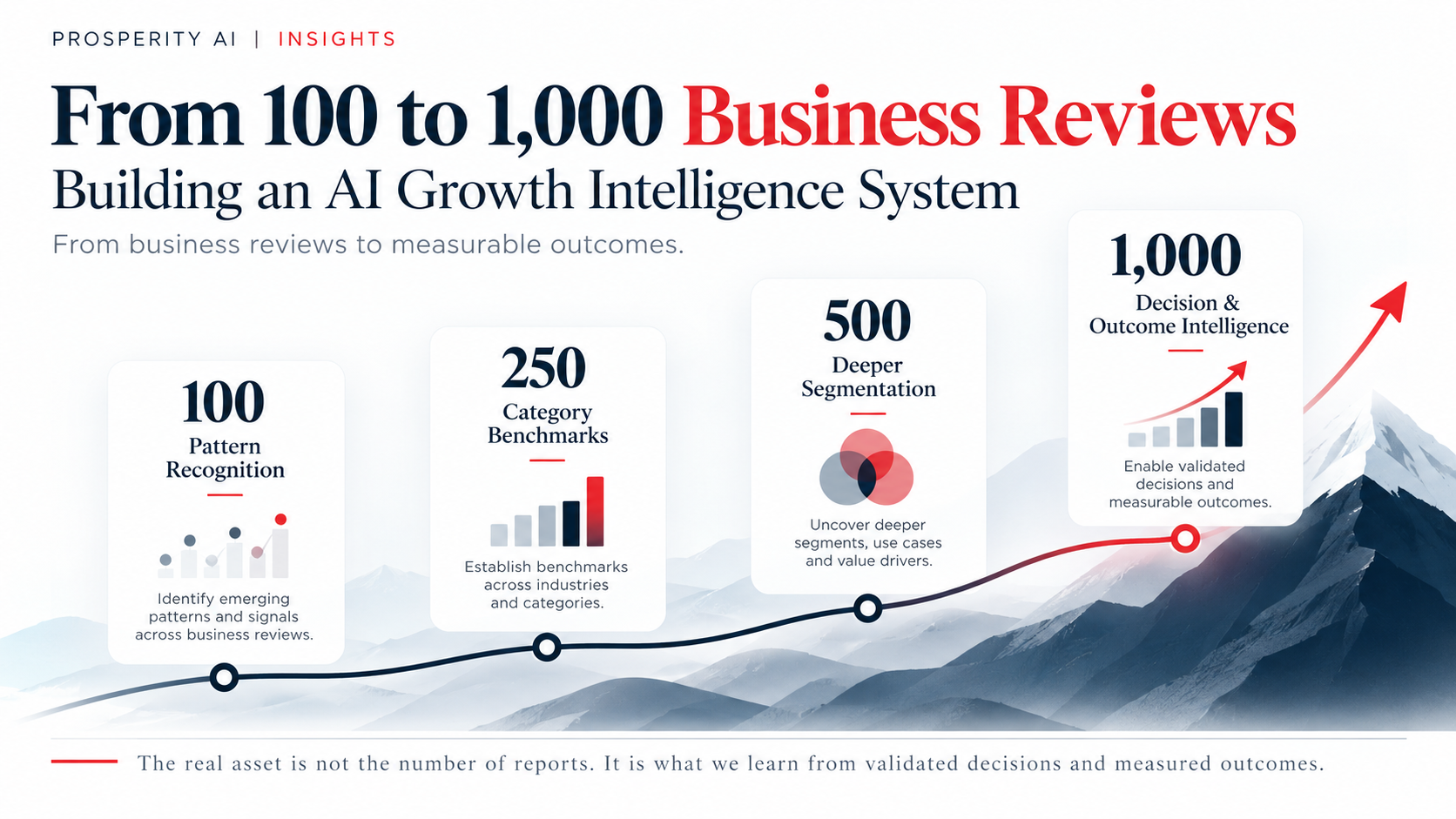
3. The Roadmap: From 100 to 1,000
Our research roadmap identifies four development milestones.
100 BUSINESS REVIEWS — Pattern Recognition
Identify recurring growth constraints, strategic weaknesses, and decision-making patterns.
250 BUSINESS REVIEWS — Category Benchmarks
Develop stronger comparative insights across business categories and GTM models.
500 BUSINESS REVIEWS — Deeper Segmentation
Analyze how strategic constraints differ by company type, target market, and growth maturity.
1,000 BUSINESS REVIEWS — Decision & Outcome Intelligence
Work toward a proprietary intelligence layer connecting business context, strategic decisions, and measured outcomes.
These milestones represent the intended evolution of the system, not a guarantee that analysis volume alone will deliver these capabilities.
4. The Missing Link: Measuring What Happens After a Decision
Traditional business analysis often ends with recommendations.
But recommendations are hypotheses until their outcomes are measured.
A company may decide to narrow its ICP, change pricing, strengthen its sales process, or invest in customer activation.
The important questions come afterward:
Was the decision implemented?
What changed?
Did the expected improvement occur?
Was the economic impact measurable?
To build meaningful Decision & Outcome Intelligence, Prosperity AI’s long-term framework connects five elements:
1. Business Context — The company’s situation when the decision was made.
2. Growth Constraint — The primary weakness the decision was intended to address.
3. Strategic Decision — The selected intervention and its expected outcome.
4. Observed Results — The measurable changes following execution.
5. Learning — What the evidence suggests about similar decisions in comparable situations.
This requires reliable follow-up information, founder validation, and outcome measurement.
Public website information alone cannot establish whether a strategic recommendation succeeded.
The value of an intelligence system increases when it can learn from verified outcomes, not merely generate more recommendations.
5. Building a Continuous Decision Intelligence System
Prosperity AI’s strategic approach follows a continuous cycle:
COMPARE → DISCOVER → DECIDE → EXECUTE → MEASURE → IMPROVE
Through Free Discover, Business Snapshot, Full Business Review + Executive Plan, and Continuous Alignment, the system is designed to help founders and CEOs move from diagnosis toward execution and measurable improvement.
Over time, validated decision-and-outcome evidence could strengthen three capabilities:
Better Diagnosis
Recognize which constraints tend to appear in similar business contexts.
Better Prioritization
Support comparisons between strategic alternatives using more relevant historical evidence.
Better Learning
Understand when recommendations generated the expected results — and when they did not.
The objective is not to replace executive judgment.
It is to make executive judgment more informed.
6. Why This Matters in the Age of AI
AI is making execution cheaper.
Businesses can research faster, develop products more efficiently, automate workflows, and launch initiatives with fewer resources.
But greater execution capacity does not eliminate the need for strategic prioritization.
It makes prioritization more important.
The competitive advantage is increasingly the ability to make the right decision at the right time — and learn from the outcome.
This is the opportunity behind AI Growth Intelligence.
Not simply more information.
Not simply more automation.
But a system capable of connecting business evidence, decisions, execution, and measurable economic results.
The Long-Term Asset Is What We Learn
The transition from 100 to 1,000 Business Reviews represents more than an expansion of research.
It is a roadmap toward a growing body of proprietary strategic intelligence.
The real value will depend on the quality of the data, the consistency of the analyses, the validation of assumptions, and the measurement of actual outcomes.
The long-term asset is not the number of reports.
It is the accumulated evidence about which decisions produce better outcomes, for which businesses, and under which conditions.
That is what we are building at Prosperity AI.
Discover Your Next Growth Decision
Every business has constraints.
The challenge is knowing which one matters most now.
Start with Prosperity AI Free Discover to identify your primary growth constraint, GTM Readiness, and highest-ROI decision.
Explore Prosperity AI
Better decisions. More growth. Better outcomes. Always.
⸻
Research Methodology & Transparency
This article builds on the Prosperity AI B2B SaaS Growth Intelligence Report 2026 — Second Edition, which synthesizes 100 public strategic assessments.
The findings are based on publicly available company information and Prosperity AI strategic frameworks. They are not audited operational or financial results, and the company sample is not statistically representative of the broader B2B SaaS market.
The progression toward 250, 500, and 1,000 reviews describes research and product-development objectives. A validated decision-and-outcome intelligence dataset requires reliable execution records, company-provided data, and outcome measurements beyond the initial public analyses.
Strategic recommendations remain hypotheses until tested against observed business results.
Methodology: This insight applies Prosperity AI’s Growth Intelligence framework to the evidence and context available for the review. Conclusions should be read with the linked evidence and validated against current business data.