Prosperity AI · Insight
The AI Value Gap: Why B2B SaaS Founders Must Measure Outcomes, Not Just Automation
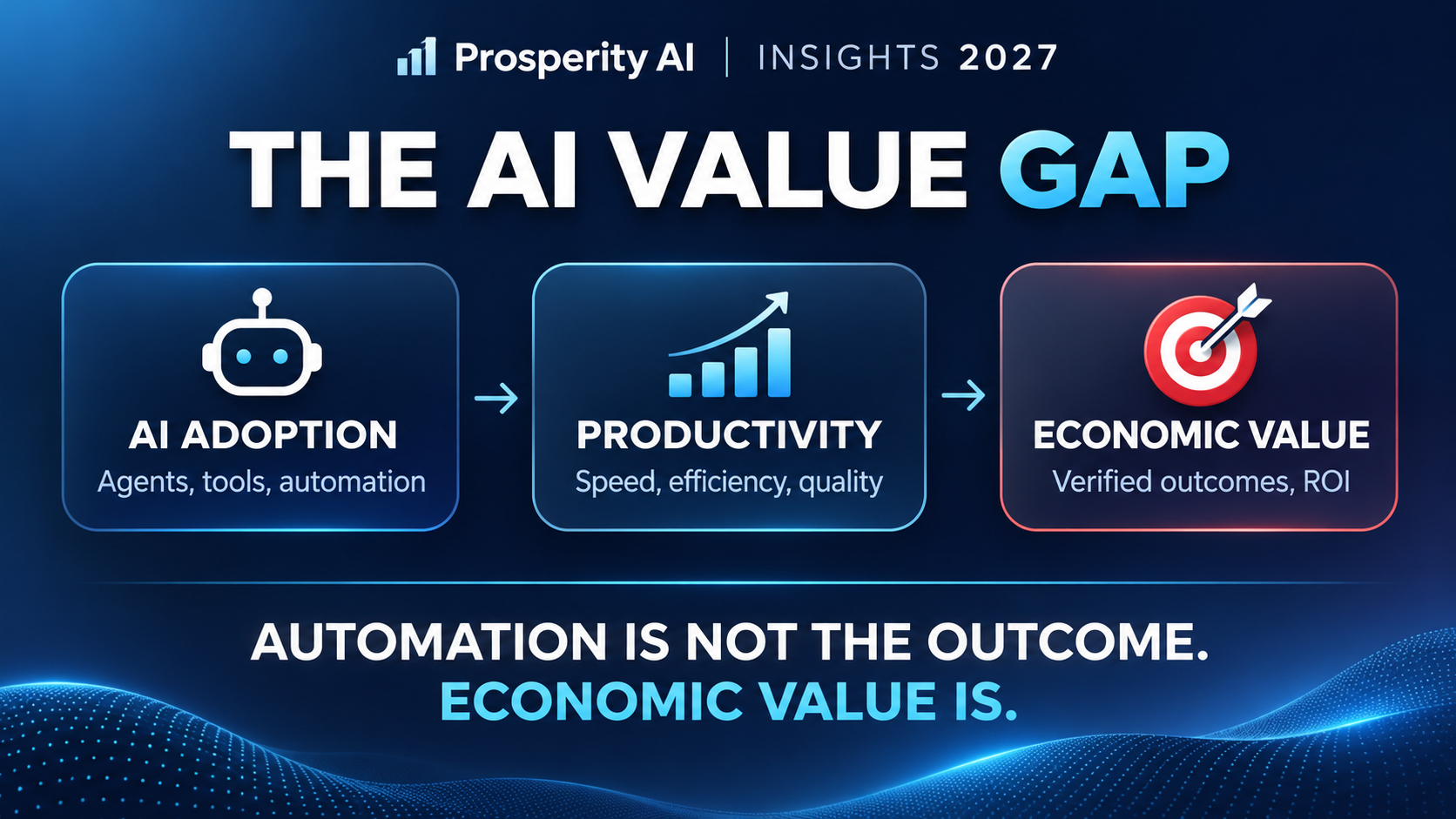
The AI Value Gap: Why B2B SaaS Founders Must Measure Outcomes, Not Just Automation
AI adoption is accelerating. But the next competitive advantage will belong to companies that can demonstrate measurable economic value.
By Prosperity AI Research Team | Prosperity AI Inc. | November 18, 2026
The Next AI Challenge Is Economic, Not Technological
B2B SaaS companies are moving rapidly from AI experimentation to deployment.
AI agents are writing code, automating customer interactions, supporting sales workflows, and executing increasingly complex tasks.
But a fundamental question remains:
Is AI actually improving the economics of the business?
A company can automate more processes, reduce task completion times, and deploy sophisticated agents without generating a meaningful financial return.
This is the AI Value Gap: the difference between what AI enables and the economic value an organization can demonstrate.
For founders heading into 2027, closing this gap may become more important than launching another AI feature.
1. What the Latest Research Reveals
McKinsey’s State of AI 2026 identifies a significant difference between productivity gains and financial results.
* 80% of respondents reported improvements in individual productivity.
* 37% reported a positive contribution from AI to organizational EBIT.
G2’s 2026 AI Agents research adds another dimension: 66% of surveyed organizations reported AI agents in limited or scaled production, while 45% said oversight and correction consumed more than one-quarter of the productivity gains they had expected.
These findings come from different surveys and should not be interpreted as measurements of the same companies.
Together, they illustrate an important strategic problem.
AI adoption, productivity improvements, and financial performance are three different outcomes.
The challenge is connecting them through reliable measurement.
2. Automation Is Not the Same as Economic Value
Consider a hypothetical B2B SaaS company introducing AI agents into customer support.
The system resolves more inquiries automatically and reduces average response times.
At first glance, the initiative appears successful.
But the complete economic picture requires additional questions:
* How much does each automated resolution cost?
* How frequently must employees review or correct agent outputs?
* Has customer satisfaction improved?
* Are operating costs actually declining?
* Has customer retention changed?
The same principle applies to AI-powered sales, marketing, product development, and analytics.
A faster process is not necessarily a more profitable process.
Founders need to measure the total cost of achieving a reliable business outcome, not simply the number of tasks automated.
3. The New Strategic Metric: Cost per Verified Outcome
Traditional SaaS performance measurement focuses on metrics such as ARR, MRR, CAC, LTV, retention, and gross margin.
These remain essential.
But AI-native workflows introduce an additional economic question:
What does it cost to produce one verified, valuable outcome?
For example, a company deploying an AI sales agent should not evaluate performance solely by the number of messages sent or leads generated.
It should consider the cost of generating qualified opportunities, including model usage, integrations, supervision, and corrections.
The commercial outcome must then be assessed through actual conversions, revenue contribution, and customer quality.
A lower cost per activity may be encouraging.
A lower cost per verified economic outcome provides stronger evidence of value.
This metric must be defined for the specific workflow and should not be presented as a universal standard.
4. Why Better Decisions Must Come Before More Automation
Imagine a B2B SaaS company struggling with declining conversion.
Management considers deploying additional AI sales agents.
But the primary constraint might be an unclear Ideal Customer Profile, weak positioning, or insufficient economic-buyer alignment.
Automating outreach could increase activity without resolving the underlying problem.
The more valuable decision may be to validate the ICP or improve the commercial message before expanding automation.
This reflects a recurring principle identified across Prosperity AI’s B2B SaaS strategic research:
Growth is a sequencing problem before it becomes a scaling problem.
The right sequence is:
IDENTIFY → VALIDATE → PRIORITIZE → EXECUTE → MEASURE → IMPROVE
Execution becomes more valuable when the company first understands which constraint the investment is intended to remove.
5. The Three Levels of AI Value Validation
Founders should distinguish three stages when evaluating an AI investment.
Level 1 — Operational Evidence
The AI system performs the intended task with measurable accuracy, reliability, and acceptable supervision requirements.
Level 2 — Business Evidence
The workflow improves a relevant business metric, such as conversion, retention, service cost, or time to value.
Level 3 — Economic Outcome
The improvement generates a measurable financial benefit after accounting for implementation, operating costs, risks, and other relevant factors.
A company may achieve operational improvements without yet demonstrating a positive economic return.
This distinction also applies to AI-generated strategic recommendations.
Hypothesized Constraints are potential problems identified through public evidence or preliminary assessments.
Validated Constraints require sufficient internal data, operational evidence, and verification.
Reliable decisions depend on understanding the difference.
6. Where Prosperity AI Fits
Prosperity AI is building an AI Growth Intelligence System designed to help companies connect strategic diagnosis, decision prioritization, execution planning, and measurable outcomes.
Its four complementary services support this process.
Free Discover helps identify the potential #1 Growth Constraint, three strategic weaknesses, GTM Readiness, and a recommended highest-ROI decision.
Business Snapshot provides an initial structured understanding of the business across five strategic dimensions.
Full Business Review + Executive Plan expands the analysis across 27 dimensions and translates priorities into a 90-day action roadmap.
Monday Morning Executive Brief supports ongoing reviews of strategic changes, priorities, risks, and previous decision outcomes.
Together, these services are designed to support a continuous decision cycle rather than isolated analysis.
The objective is not to replace GTM execution tools, CRM platforms, or AI agents.
It is to help leadership teams determine what deserves priority, what needs validation, and how success should be measured.
7. The Decision Every Founder Should Make Before 2027
Before approving another major AI investment, answer four questions:
1. What business constraint are we trying to remove?
2. Which measurable outcome should improve?
3. What is the total cost of achieving that outcome?
4. What evidence will demonstrate that the intervention worked?
If these questions cannot be answered, the next priority may be improving the diagnosis rather than expanding implementation.
The goal is not to slow innovation.
It is to make innovation economically accountable.
Conclusion — The Future of AI Is Measured Value
AI is making execution faster, cheaper, and more accessible.
But competitive advantage will not come simply from deploying more agents or automating more tasks.
It will increasingly depend on understanding which interventions create meaningful business improvements and proving their economic value.
The next generation of B2B SaaS winners won’t just automate more. They will know what to automate, why it matters, and whether it actually works.
That is the future of AI Growth Intelligence we are building at Prosperity AI.
Discover Your Next Growth Decision
Before investing more in AI execution, identify the constraint that matters most.
START FREE DISCOVER
Explore Prosperity AI.
Better decisions. More growth. Better outcomes. Always.
Research & Methodology
This article combines published industry research with Prosperity AI’s strategic decision framework. The business examples are hypothetical, not verified customer results. Survey findings concern different respondent populations and should not be treated as representative of all B2B SaaS companies.
Observed operational improvements do not automatically demonstrate financial ROI or causation. Outcome verification requires reliable baselines, comparable data, cost accounting, and appropriate consideration of external factors.
Sources: McKinsey & Company — The State of AI in 2026: On the Road to ROI (August 2026); G2 — 2026 AI Agents Insight Report: Crossing the Agentic Chasm (October 2026); IDC — Beyond the SaaSpocalypse: The Pricing Question Most Vendors Aren’t Answering (November 2026).
Methodology: This insight applies Prosperity AI’s Growth Intelligence framework to the evidence and context available for the review. Conclusions should be read with the linked evidence and validated against current business data.