Prosperity AI · Insight
How B2B SaaS Is Changing in the San Francisco Bay Area: The Rise of AI Growth Intelligence
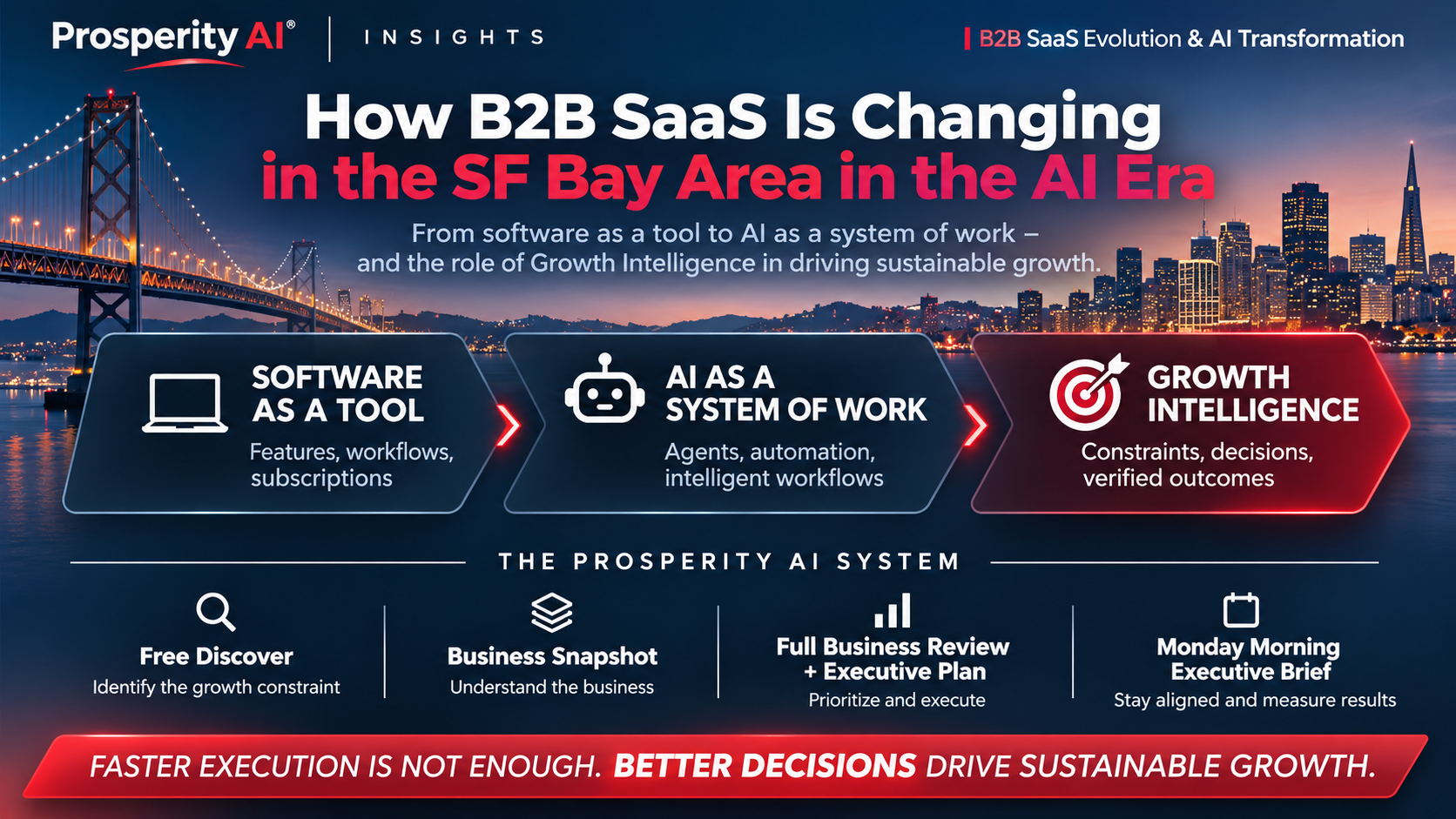
How B2B SaaS Is Changing in the San Francisco Bay Area: The Rise of AI Growth Intelligence
What our research across 148 B2B SaaS companies reveals about the transition to AI-native software, and why better decisions are becoming essential for sustainable growth.
By Pierluigi Merico | Founder & CEO, Prosperity AI Inc. | November 21, 2026
The San Francisco Bay Area Is Reinventing Software
The San Francisco Bay Area has long been one of the world’s most influential ecosystems for software innovation.
Today, artificial intelligence is accelerating another major transformation.
Software development is becoming faster. AI agents are increasingly capable of executing workflows. Small teams can build sophisticated products, while established SaaS companies are reconsidering how their platforms create value.
But technological acceleration introduces a fundamental strategic challenge.
When every company can build and execute faster, how do founders determine what actually deserves investment?
At Prosperity AI, our research program has expanded to 148 B2B SaaS strategic analyses, focused primarily on companies in the San Francisco Bay Area.
The documented findings from our first 100 reviews reveal recurring challenges involving ICP clarity, positioning, economic-buyer alignment, commercial repeatability, and decision sequencing.
The central lesson is increasingly relevant:
Growth is a sequencing problem before it becomes a scaling problem.
1. From Software Features to AI-Native Value Creation
Traditional B2B SaaS companies created value by organizing information, digitizing processes, and improving workforce productivity.
AI is changing what customers expect from software.
Instead of simply accessing features, companies increasingly want systems capable of understanding context, supporting decisions, and executing useful work.
This transformation affects three fundamental areas:
Product: From interfaces and features toward intelligent workflows, agents, and automation.
Business Model: From predominantly seat-based subscriptions toward combinations of subscriptions, usage, and potentially outcome-linked pricing.
Customer Value: From access to software toward demonstrable improvements in productivity, efficiency, and business results.
These transitions are not uniform. Different software categories will evolve at different speeds, and traditional subscriptions will remain appropriate for many products.
The important question is whether the company can demonstrate why its AI capabilities create measurable customer value.
2. What Our B2B SaaS Research Reveals
Our B2B SaaS Growth Intelligence Report 2026 — Second Edition, covering the first 100 public strategic analyses, identified recurring weaknesses across several business dimensions.
Technical Adoption Without Economic-Buyer Alignment
Companies such as Chroma and Momentic illustrated how technical credibility can coexist with unanswered questions about commercial positioning and buyer value.
Broad ICPs and Unclear Market Focus
Analyses including Clidey/WhoDB and Assemble highlighted the strategic complexity of addressing multiple customer segments or use cases before establishing a repeatable commercial motion.
GTM Repeatability and Sales Visibility
The reviews of Nango and Browserbase raised different questions about buying-group coverage, acquisition processes, pipeline visibility, and commercial scaling.
AI Differentiation
Across AI infrastructure, agents, developer tools, and automation, broad technology positioning can make it difficult for customers to identify a distinctive economic advantage.
These findings are based on public information and strategic interpretation, not verified internal company performance.
They identify potential constraints requiring further validation.
Nevertheless, the pattern is important:
Building advanced technology and building a scalable commercial system are different challenges.
3. The New Growth Constraint: Turning AI Capabilities Into Economic Value
AI-native companies can launch products faster, automate workflows, and expand their capabilities with smaller teams.
But faster execution can also amplify unresolved strategic weaknesses.
Consider three illustrative situations.
Company A - Strong Product, Weak Conversion
Users adopt an AI product, but relatively few become paying customers.
The priority may be activation, positioning, or willingness-to-pay validation rather than additional acquisition.
Company B - Rapid Adoption, Unclear Economics
Revenue increases, but model inference costs, customer support, and acquisition spending also rise.
The strategic priority may be improving contribution margin and cost per valuable customer outcome.
Company C - Broad AI Platform, Unvalidated ICP
The company offers multiple capabilities across several markets.
The more valuable decision may be narrowing the initial customer segment and proving one repeatable use case before expanding.
The common principle:
More AI capabilities do not automatically generate more sustainable growth.
The highest-value decision depends on the constraint currently limiting business performance.
4. Why Decision Intelligence Is Becoming More Valuable
As AI reduces the cost of execution, companies can pursue more initiatives simultaneously.
But management attention, investment capital, and organizational decision capacity remain limited.
This creates a new competitive challenge.
Execution capacity is increasing faster than many organizations’ ability to prioritize effectively.
The critical questions become:
1. What is changing in our market and customer behavior?
2. What is our primary growth constraint?
3. Which strategic assumptions are supported by evidence?
4. Which decision offers the strongest expected economic return?
5. How will we measure whether the decision worked?
These questions define the role of Growth Intelligence.
Traditional analytics helps explain business performance. Growth Intelligence seeks to connect evidence, diagnosis, strategic alternatives, execution priorities, and measurable outcomes.
The objective is not to replace management judgment.
It is to make business decisions more structured, evidence-based, and accountable.
5. How Prosperity AI Helps Build a Continuous Growth System
Prosperity AI is building an AI Growth Intelligence System designed to complement existing CRM, analytics, product, and GTM execution tools.
Its four core services support different stages of the decision cycle.
01 - Free Discover: Identify the Constraint
A free initial assessment that helps founders explore their potential #1 Growth Constraint, three strategic weaknesses, GTM Readiness, and a recommended highest-ROI decision.
02 - Business Snapshot: Understand the Business
An assessment of five core strategic dimensions, creating a structured starting point for evaluating market positioning, customer problems, and the business model.
03 - Full Business Review + Executive Plan: Prioritize Action
A deeper assessment across 27 strategic dimensions, connecting potential growth constraints with prioritized decisions and a 90-day Executive Plan.
04 - Monday Morning Executive Brief: Maintain Alignment
A recurring review of meaningful changes, strategic priorities, risks, recommended actions, and previous decision outcomes.
Together, these services are designed to support:
IDENTIFY → VALIDATE → PRIORITIZE → EXECUTE → MEASURE → IMPROVE
This is the essential difference between generating another business report and developing a continuous Growth Intelligence process.
A report describes a situation.
A decision system helps determine what matters next and how progress should be evaluated.
6. From Research to Decision & Outcome Intelligence
The long-term opportunity extends beyond analyzing individual SaaS companies.
As Prosperity AI expands its research, recurring strategic patterns can inform stronger comparisons across company types, market categories, and GTM maturity.
But accumulating more reviews is only the first stage.
The more valuable opportunity is connecting business context, strategic decisions, and observed outcomes.
That requires distinguishing:
Hypothesized Constraints: Potential limitations inferred from public evidence or preliminary assessments.
Validated Constraints: Limitations supported by adequate internal customer, operational, and financial evidence.
Measured Outcomes: Results observed after a decision has been implemented and evaluated.
Over time, consistently collected and permissioned decision-outcome evidence could support more useful recommendations for comparable businesses.
The long-term asset is not simply the number of Business Reviews. It is the accumulated knowledge about which decisions produce better outcomes, for which businesses, and under which conditions.
That remains a strategic development objective, not a claim that the 148 public analyses already establish verified causal outcomes.
7. The Strategic Priority for B2B SaaS Founders in 2027
The next generation of SaaS companies will compete in markets where AI capabilities become increasingly accessible.
Product development speed alone may not provide durable differentiation.
Founders will need stronger customer understanding, clear positioning, defensible workflows, sustainable economics, and the ability to demonstrate measurable value.
Before committing additional capital to AI features, sales capacity, or distribution, leadership teams should ask:
What is preventing our company from turning its existing capabilities into greater economic value?
The answer may involve product activation, ICP validation, economic-buyer alignment, pricing, retention, or operational efficiency.
The correct priority will differ across businesses.
The competitive advantage is not simply executing faster. It is knowing what deserves execution and learning from the results.
Conclusion - From AI Acceleration to Sustainable Growth
The San Francisco Bay Area is demonstrating how AI can transform the speed, economics, and capabilities of software companies.
But market momentum is not the same as sustainable competitive advantage.
The companies best positioned for long-term growth may be those that combine AI capabilities with clear customer value, disciplined prioritization, and measurable economic outcomes.
This is the challenge Prosperity AI is designed to address.
AI makes execution faster. Growth Intelligence helps founders decide what deserves execution.
And continuous outcome measurement can make the next decision more informed.
That is the future of business growth we are building at Prosperity AI.
Discover Your Next Growth Decision
Before accelerating another growth initiative, identify what may be limiting your business.
START FREE DISCOVER
Better decisions. More growth. Better outcomes. Always.
Research & Methodology
Prosperity AI’s research program is reported to include 148 B2B SaaS strategic analyses. The qualitative patterns discussed here are supported by the published Second Edition covering the first 100 reviews; they are not presented as a new quantitative analysis of all 148 companies.
The assessments are based on publicly available information and are not statistically representative of the entire San Francisco Bay Area B2B SaaS market. Some companies reviewed may fall outside the core geography.
Public-data conclusions are strategic hypotheses requiring validation against internal company evidence. The business scenarios are illustrative and do not represent verified customer outcomes.
Sources: Prosperity AI - B2B SaaS Growth Intelligence Report 2026, Second Edition; BCG - As AI Reshapes SaaS, Companies Need Pivot-Ready Pricing (October 2026); Deloitte - SaaS Meets AI Agents (2026).
Methodology: This insight applies Prosperity AI’s Growth Intelligence framework to the evidence and context available for the review. Conclusions should be read with the linked evidence and validated against current business data.