Prosperity AI · Insight
What Is AI Growth Intelligence?
What Is AI Growth Intelligence?
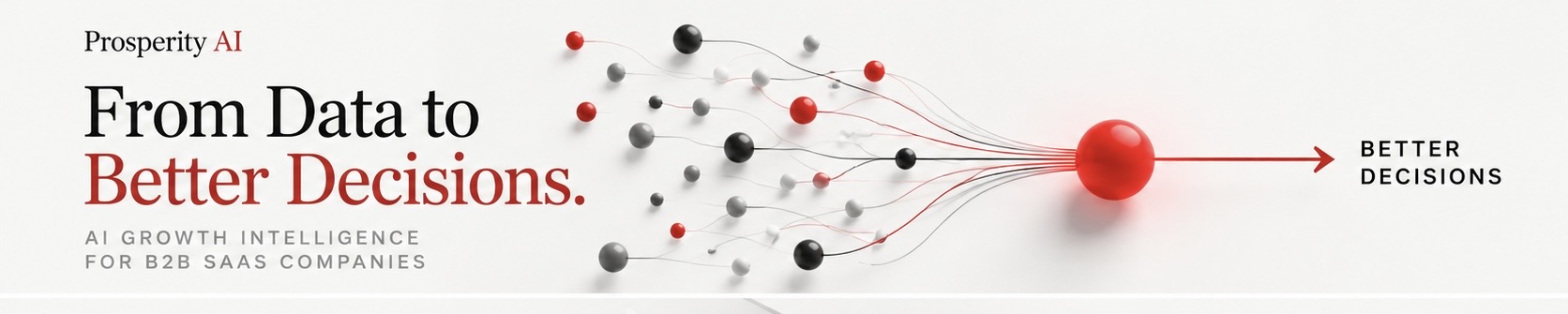
The next competitive advantage in business is not simply better execution. It is knowing what to execute.
Artificial intelligence is transforming how companies build products, automate workflows, analyze information, and serve customers.
Execution is becoming faster, cheaper, and increasingly accessible.
But this creates a new challenge.
When companies can execute more initiatives than ever before, how do they know which initiatives actually matter?
This is the problem AI Growth Intelligence is designed to solve.
Defining AI Growth Intelligence
AI Growth Intelligence is the use of artificial intelligence to continuously understand a business, identify its most important growth constraints, evaluate strategic alternatives, prioritize high-ROI decisions, and improve growth strategy as new evidence becomes available.
Unlike traditional business analytics, which primarily explains what happened, AI Growth Intelligence focuses on what the business should do next.
It connects business understanding, strategic diagnosis, decision-making, execution planning, and continuous learning.
Its purpose is not to generate more recommendations.
Its purpose is to improve the quality of decisions that influence business growth.
Why Businesses Need Growth Intelligence
Most businesses do not suffer from a lack of opportunities.
They suffer from too many competing priorities.
A B2B SaaS company might simultaneously consider:
* Expanding into a new market.
* Increasing marketing expenditure.
* Launching additional product features.
* Changing its pricing model.
* Hiring more salespeople.
* Improving onboarding and activation.
* Investing in AI automation.
Each initiative could create value.
But not every initiative deserves attention now.
The economic challenge is deciding which action will create the greatest impact given the company’s current constraints, resources, and market conditions.
Growth Intelligence turns strategic complexity into prioritized decisions.
The Five Components of AI Growth Intelligence
1. Business Understanding
Before recommending action, an intelligence system must understand the business.
This includes its target customers, customer problems, value proposition, differentiation, revenue model, positioning, go-to-market approach, and growth objectives.
A useful strategic recommendation depends on the quality of this understanding.
2. Growth Constraint Identification
Every business faces constraints that limit its ability to grow.
Examples include an unclear ideal customer profile, weak differentiation, ineffective acquisition channels, onboarding friction, low retention, or misaligned pricing.
The objective is to identify the constraint that currently has the greatest influence on growth.
3. Decision Intelligence
Once the constraint is understood, the next challenge is selecting the highest-value response.
AI Growth Intelligence evaluates strategic alternatives according to potential economic impact, feasibility, urgency, available evidence, and execution requirements.
The result should be a prioritized decision rather than a disconnected collection of suggestions.
4. Execution Intelligence
A strategic decision creates value only when it leads to action.
Execution Intelligence translates decisions into clear priorities, measurable outcomes, and a practical sequence of activities.
This includes identifying what to do now, what to do next, and what should not be prioritized yet.
5. Continuous Intelligence
Business conditions change.
Customer behavior evolves. Competitors introduce new products. Acquisition economics shift. Previous decisions generate new evidence.
A continuous intelligence system should reassess priorities as information changes and compare expected outcomes with observed results.
This creates the foundation for progressively better decisions.
AI Growth Intelligence vs. Traditional Business Intelligence
Traditional Business Intelligence helps organizations understand performance through dashboards, reports, and historical data.
AI Growth Intelligence addresses a different question.
Traditional Business Intelligence: What happened?
AI Growth Intelligence: What is constraining growth, what should we do next, and how will we know whether the decision worked?
These approaches are complementary.
Business Intelligence provides important evidence.
Growth Intelligence uses evidence to support strategic decisions.
Why AI Growth Intelligence Matters for B2B SaaS
B2B SaaS companies operate in highly competitive markets where growth depends on several interconnected factors.
These include customer acquisition, activation, retention, expansion, pricing, product-market fit, and go-to-market efficiency.
Improving one metric does not necessarily improve the business.
For example, increasing lead generation may create little economic value if the actual constraint is poor customer activation.
Similarly, expanding product functionality may not improve growth if customers do not understand the existing value proposition.
AI Growth Intelligence helps companies focus on the constraint that matters most before committing additional resources.
How Prosperity AI Applies Growth Intelligence
Prosperity AI is building an AI Growth Intelligence System focused on B2B SaaS businesses.
The system is designed to support a connected decision process:
Understand → Diagnose → Decide → Plan → Execute → Measure → Learn
It begins with business understanding, including information available from a company’s website.
The Business Snapshot examines five strategic dimensions and identifies initial growth constraints and decision priorities.
The Full Business Review expands the analysis across 27 strategic dimensions and connects the findings to an Executive Plan.
Continuous Alignment and the Monday Morning Executive Brief extend the approach toward recurring strategic intelligence.
Publicly available information provides a starting point. Internal customer, financial, operational, and product data can materially change the assessment and improve decision quality.
The Future of Growth Intelligence
As AI makes execution increasingly accessible, competitive advantage will depend more heavily on the ability to select the right priorities.
The companies that succeed will not necessarily be those executing the greatest number of initiatives.
They will be those consistently identifying the most important constraint, making better decisions, measuring the outcomes, and adapting faster.
When execution becomes abundant, prioritization becomes scarce.
That is why AI Growth Intelligence matters.
Start With Your Business
Discover what may be constraining your growth and identify the decision that deserves attention next.
Run the same analysis on your business.
https://app.prosperityai.ai/
Prosperity AI
Better decisions. More growth. Better outcomes. Always.
Methodology: This insight applies Prosperity AI’s Growth Intelligence framework to the evidence and context available for the review. Conclusions should be read with the linked evidence and validated against current business data.