Prosperity AI · Insight
When Should a B2B SaaS Founder Use Prosperity AI Instead of a General AI Assistant?
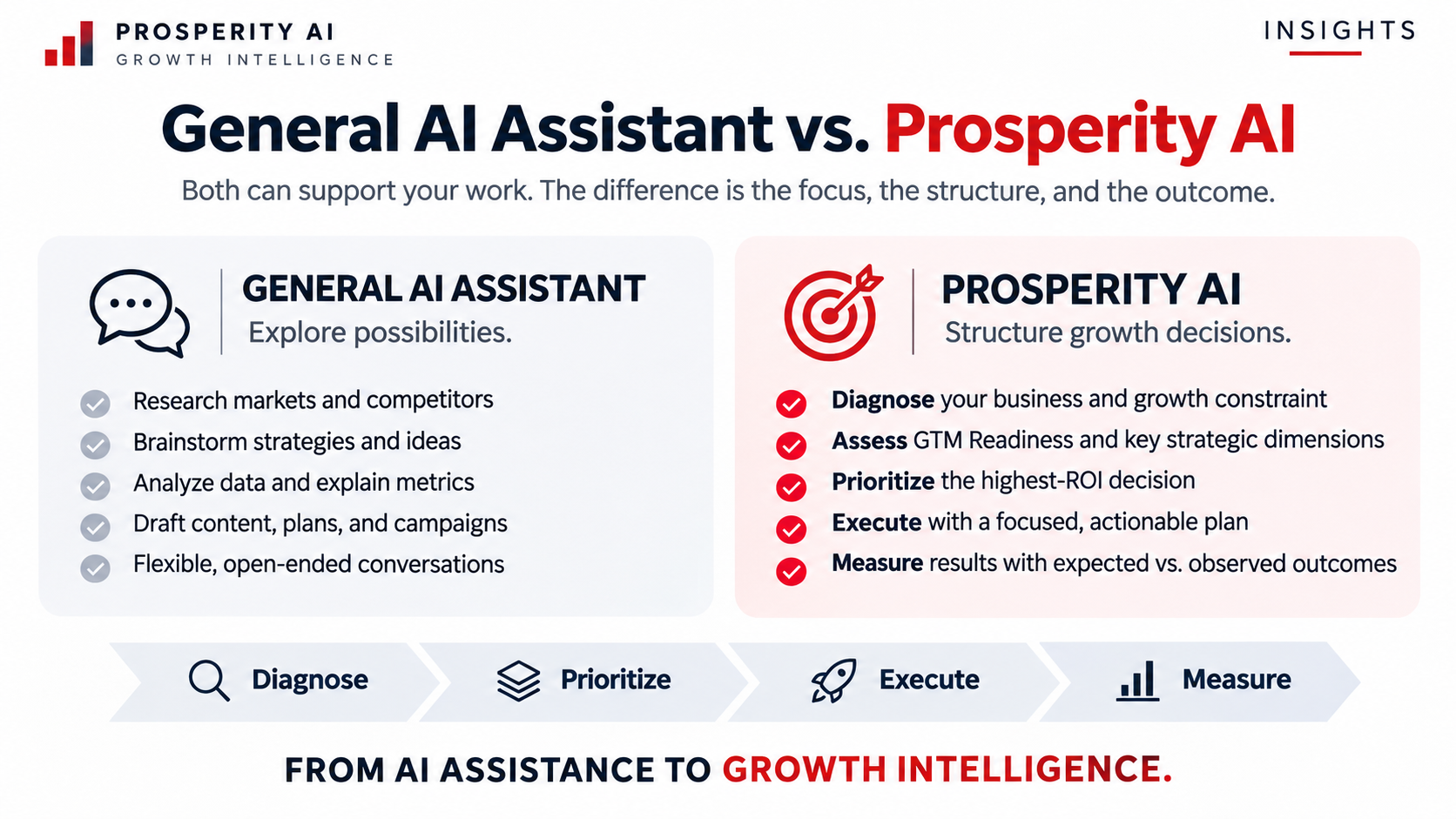
When Should a B2B SaaS Founder Use Prosperity AI Instead of a General AI Assistant?
Why asking better questions is valuable, but building a structured system for better business decisions matters even more.
By Prosperity AI Research Team
November 5, 2026
AI Can Answer Business Questions. But Can It Help You Decide What Matters Most?
General AI assistants have become powerful tools for founders.
They can help research markets, analyze information, explore strategic alternatives, write business plans, and interpret financial metrics.
These capabilities create significant value.
But B2B SaaS founders face a more specific challenge.
They need to understand why growth is slowing, identify their most important constraint, prioritize investment, and determine whether their decisions actually work.
The question is not whether a general AI assistant can provide business advice.
The question is whether the founder needs an open-ended conversation or a structured, repeatable decision process.
That is the distinction behind Prosperity AI.
1. When a General AI Assistant Is Enough
General AI assistants are useful when founders need flexibility.
For example:
* Researching a new market.
* Exploring customer acquisition strategies.
* Drafting sales messages.
* Brainstorming positioning alternatives.
* Understanding SaaS metrics.
* Summarizing customer feedback.
* Evaluating an initial business hypothesis.
A general assistant can also perform sophisticated business analysis when provided with reliable data, appropriate instructions, and a clear framework.
For many individual tasks, that may be entirely sufficient.
However, the founder remains responsible for defining the analytical methodology, maintaining consistency, and deciding how different findings should influence priorities.
2. When Prosperity AI Becomes Relevant
Prosperity AI is designed for a more structured business objective:
Identify the number-one growth constraint and determine which strategic decision deserves priority.
Instead of beginning with an unrestricted conversation, the system uses a defined business assessment framework.
Its capabilities include:
Business Snapshot
An initial analysis of five strategic dimensions: market, customer pain, product, value proposition, and competitive differentiation.
Full Business Review
A deeper assessment across 27 strategic dimensions, including GTM, pricing, operations, financial considerations, and scalability.
Executive Plan
A prioritized set of actions designed to connect the strategic diagnosis to execution.
Continuous Alignment
A framework for revisiting strategic priorities as business conditions and available evidence change.
Decision Measurement
Connecting expected outcomes, measurement dates, observed results, and decision success assessments.
The objective is to move from isolated recommendations toward a more consistent decision-making process.
3. Example: Revenue Growth Is Slowing
Consider a hypothetical B2B SaaS company experiencing declining revenue growth.
The founder asks a general AI assistant:
“How can I accelerate SaaS revenue growth?”
The assistant might suggest improving marketing, refining pricing, strengthening onboarding, expanding partnerships, or hiring additional salespeople.
These suggestions may all be reasonable.
But which should come first?
The Prosperity AI Approach
A structured assessment examines the business context.
Suppose the available evidence shows:
* Website traffic is increasing.
* Customer acquisition costs are rising.
* Trial-to-paid conversion is declining.
* Existing customers demonstrate strong retention.
The primary constraint may be activation or conversion rather than insufficient demand.
Instead of recommending more acquisition activity, the strategic priority could be improving onboarding.
Diagnosis: Weak conversion of existing demand.
Decision: Test improvements to onboarding and activation before increasing acquisition spending.
Expected Outcome: Improve trial-to-paid conversion within a defined measurement period.
Observed Outcome: Evaluate actual conversion, customer quality, and implementation costs after execution.
This is an illustrative example, not a verified customer result.
The important difference is the sequence:
DIAGNOSE → PRIORITIZE → EXECUTE → MEASURE
4. Why GTM Readiness Requires More Than Generic Advice
B2B SaaS growth depends on interconnected commercial factors.
A company may demonstrate strong technical adoption while lacking economic-buyer alignment.
It may have a large addressable market without a validated Ideal Customer Profile.
Or it may generate significant pipeline activity without establishing repeatable acquisition economics.
Prosperity AI’s first 100 public Business Reviews in the San Francisco Bay Area identified recurring patterns involving these strategic weaknesses.
The findings reinforce a central principle:
Growth is a sequencing problem before it becomes a scaling problem.
For founders considering major investments in marketing, sales, or expansion, a structured GTM Readiness assessment can help identify which assumptions require validation first.
5. The Difference Is Not the AI Model. It Is the Decision Framework.
A general AI assistant and Prosperity AI are not mutually exclusive.
Both can contribute to the founder’s workflow.
The distinction is in how intelligence is organized and applied.
General AI Assistant Prosperity AI
Open-ended questions and analysis Structured business assessment
Broad knowledge across subjects Growth-focused strategic framework
Flexible recommendations Constraint-based prioritization
User-defined analytical process Defined strategic dimensions
Follow-up through conversation and available tools Decision and outcome tracking framework
General-purpose productivity Business growth decision support
These are differences in product focus, not exclusive capabilities.
A sufficiently configured general AI assistant can also perform structured diagnosis, maintain context, and evaluate outcomes.
Prosperity AI’s intended advantage is providing a consistent framework specifically organized around the growth decisions facing founders and CEOs.
6. Why Outcome Measurement Matters
Generating a recommendation is only the beginning.
Suppose a company decides to narrow its ICP.
The initial assessment may suggest that a focused customer segment could improve acquisition efficiency.
But the recommendation has not been validated simply because it was generated.
The founder needs to measure whether the intervention produced the expected effect.
Relevant indicators might include:
* Qualified lead conversion.
* Sales-cycle duration.
* Customer acquisition cost.
* Average contract value.
* Retention and contribution margin.
These measurements help determine whether the decision should be maintained, adjusted, or reconsidered.
A business becomes more intelligent when it learns from the outcomes of its decisions, not merely from the number of recommendations it receives.
That is the foundation of Prosperity AI’s Decision & Outcome Intelligence approach.
7. General AI and Prosperity AI Can Work Together
The most useful choice is not necessarily one tool instead of the other.
A founder might use a general AI assistant to research competitors, explore new positioning ideas, or draft an acquisition campaign.
Prosperity AI can provide a structured assessment of which strategic constraint deserves attention and how the selected intervention should be evaluated.
The company’s existing CRM, analytics, billing, and marketing tools can then support execution and measurement.
Prosperity AI is designed to sit on top of your existing stack.
Its role is to help connect business understanding, strategic priorities, execution planning, and measurable results.
8. When Should You Choose Prosperity AI?
Consider using Prosperity AI when:
* You have several growth problems but cannot identify which one matters most.
* You need to assess whether your GTM strategy is ready to scale.
* You are comparing significant business investment alternatives.
* You want a structured review across multiple strategic dimensions.
* You need a prioritized Executive Plan.
* You want to connect strategic decisions to measurable outcomes.
For isolated research, writing, or brainstorming tasks, a general AI assistant may be sufficient.
For recurring business diagnosis and structured growth prioritization, Prosperity AI offers a purpose-built approach.
The Bottom Line: From AI Assistance to Growth Intelligence
AI assistants are changing how founders work.
But the strategic challenge remains:
What should we do next, why does it matter, and how will we know whether it worked?
Prosperity AI is being built around these questions.
Not simply to generate more business advice.
But to help founders identify the constraint that matters most, prioritize their next strategic decision, and evaluate its outcome.
General AI helps you explore possibilities.
AI Growth Intelligence helps structure the path from evidence to decisions and measurable results.
Discover Your Next Growth Decision
Before increasing marketing investment, expanding your sales team, or launching another growth initiative, identify what may be constraining your business.
Start with Prosperity AI Free Discover to explore your primary growth constraint, strategic weaknesses, GTM Readiness, and highest-ROI decision.
Start Free Discover
For deeper strategic analysis, explore Business Snapshot and Full Business Review + Executive Plan.
Explore Prosperity AI
Better decisions. More growth. Better outcomes. Always.
⸻
Method
Methodology: This insight applies Prosperity AI’s Growth Intelligence framework to the evidence and context available for the review. Conclusions should be read with the linked evidence and validated against current business data.