Prosperity AI · Insight
The Market Creates Momentum. Decision Intelligence Creates Sustainable Growth.
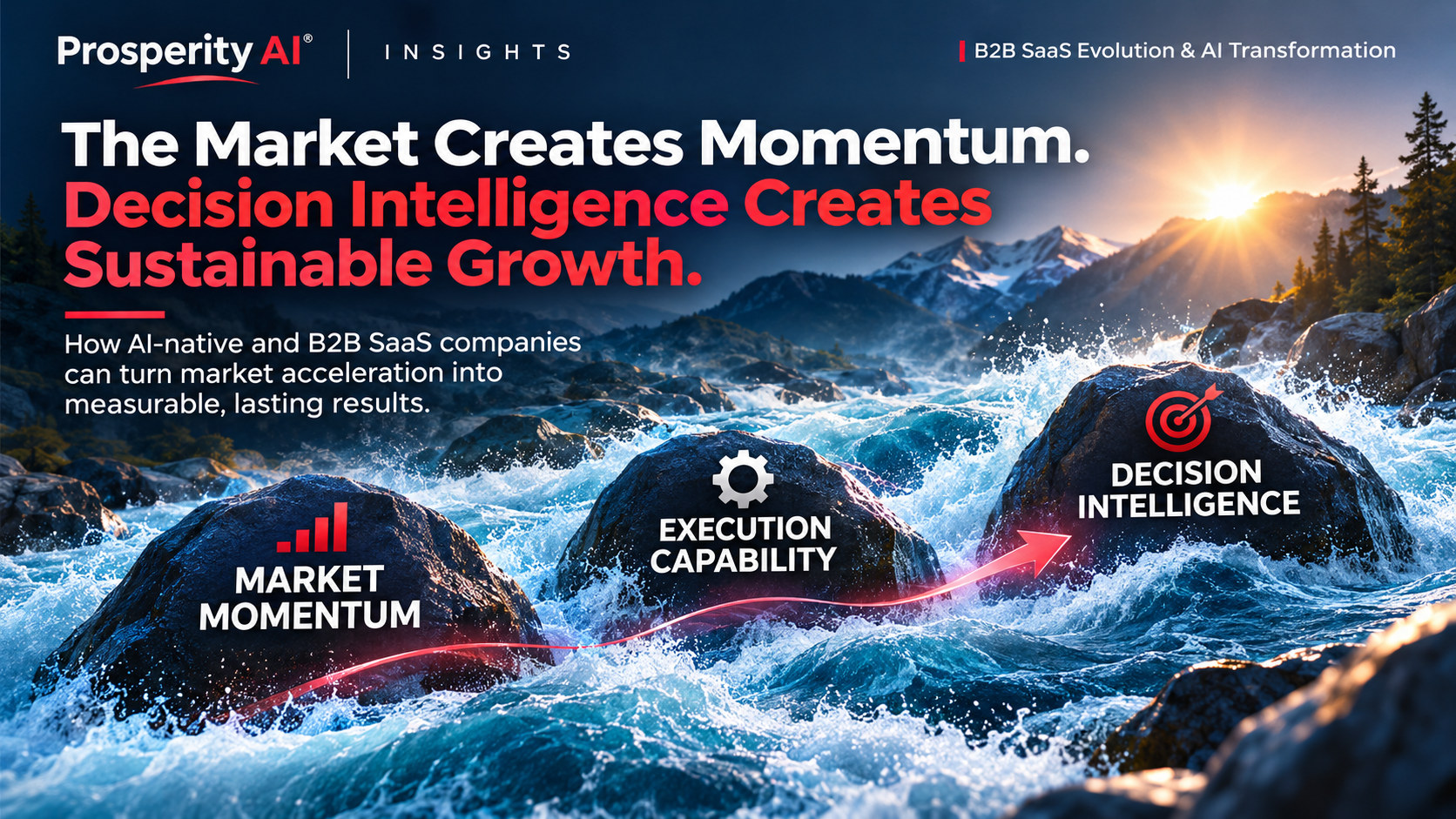
The Market Creates Momentum. Decision Intelligence Creates Sustainable Growth.
Why the next competitive advantage for AI-native and B2B SaaS companies is not simply growing faster, but making better decisions while the market accelerates.
By Pierluigi Merico | Founder & CEO, Prosperity AI Inc. | November 20, 2026
1. The New Reality of AI-Native Growth
AI-native companies are challenging traditional assumptions about how software businesses scale.
Product development cycles are shrinking. Small teams can achieve what once required much larger organizations. Distribution increasingly happens through founders, employees, customers, and products themselves.
Meanwhile, market opportunities can emerge and expand in months rather than years.
Elena Verna, Head of Growth at Lovable, recently introduced the Whitewater Framework to explain how companies navigate rapidly expanding markets.
Her central insight is that extraordinary growth is not driven solely by a company’s internal growth engine. External market forces can create powerful acceleration.
The market creates the current. The organization must develop the capabilities to navigate it.
But this raises an important strategic question:
Does capturing market momentum necessarily create a sustainable competitive advantage?
Not always. Rapid adoption can generate impressive growth without establishing durable customer relationships, defensible differentiation, or sustainable economics.
This is where Growth Intelligence becomes increasingly relevant.
2. The Whitewater Framework: Navigating the River
Traditional growth frameworks emphasize optimizing internal growth engines.
The Whitewater Framework adds the importance of external market acceleration and the organizational capabilities needed to capture it.
Verna identifies seven components:
* Exceptional Product: Deliver meaningful customer value.
* Culture of Trust: Enable autonomy, accountability, and decentralized decisions.
* Shipping Velocity: Continuously improve and release products.
* AI Automation: Reduce repetitive work and increase organizational capacity.
* Lean Teams: Maintain adaptability and speed.
* Personality-Driven Distribution: Activate founders, employees, customers, and partners.
* Strategic Big Bets: Make consequential decisions despite uncertainty.
Together, these capabilities help companies respond to fast-moving markets.
But their effectiveness depends on where resources are directed.
An exceptional product can attract users without sufficient willingness to pay. Faster releases can increase activity without improving retention. Distribution can generate demand without sustainable customer economics.
Speed creates opportunities. It does not automatically establish progress.
3. The Hidden Risk: Confusing Market Growth With Company Strength
When an entire market accelerates, companies can experience substantial growth even while important weaknesses remain unresolved.
Consider three hypothetical AI-native businesses.
Company A — Rapid Acquisition, Weak Retention
Registrations are growing quickly, but many customers abandon the product after their initial experience.
Management increases acquisition spending, although the underlying constraint may be insufficient recurring customer value.
Company B — Exceptional Technology, Unclear Positioning
The company offers advanced AI capabilities but cannot clearly communicate which customer problem it solves better than alternatives.
Additional product features may increase complexity without improving commercial differentiation.
Company C — Growing Revenue, Weak Unit Economics
Customer demand is increasing, but inference costs, support requirements, and acquisition expenses rise alongside revenue.
The company demonstrates growth without establishing whether incremental customers create attractive contribution margins.
These examples illustrate a fundamental principle:
The most visible growth symptom is not necessarily the underlying growth constraint.
More marketing does not automatically solve retention problems. More features do not necessarily improve positioning. Higher revenue does not guarantee sustainable economics.
The strategic priority is identifying which limitation currently prevents the business from creating greater value.
4. The Missing Layer: Growth Intelligence
The Whitewater Framework describes capabilities that help organizations capture extraordinary market momentum.
Prosperity AI proposes a complementary layer: Growth Intelligence, a continuous process for identifying, validating, prioritizing, and measuring strategic decisions.
For AI-native and B2B SaaS companies, five questions matter.
1. What is changing?
Monitor customer behavior, competitive dynamics, technology, pricing, and demand.
2. What is constraining growth?
Identify potential limitations across positioning, acquisition, activation, retention, and unit economics.
3. What evidence supports the diagnosis?
Distinguish hypotheses based on public information from constraints validated through internal operational and customer evidence.
4. Which decision offers the highest expected return?
Compare strategic alternatives using expected impact, cost, risk, feasibility, and timing.
5. Did the decision work?
Define expected outcomes, measure observed results, and use the evidence to improve subsequent decisions.
The resulting cycle is:
IDENTIFY → VALIDATE → PRIORITIZE → EXECUTE → MEASURE → ADAPT
The objective is not to eliminate uncertainty. It is to make uncertainty more manageable and decisions more accountable.
5. From Growth Velocity to Decision Effectiveness
AI-native companies are increasing execution capacity.
They can develop software faster, automate workflows, launch experiments, and produce content with fewer resources.
But faster execution introduces a strategic risk.
Companies can now pursue more initiatives without necessarily improving their ability to identify which initiatives matter most.
A team may release ten features without understanding which one creates the greatest customer value.
It may run dozens of campaigns without recognizing that activation or retention is the primary constraint.
It may automate processes that should have been simplified or eliminated.
The ability to execute more decisions does not automatically improve the quality of those decisions.
The next productivity frontier is therefore not only execution efficiency. It is decision effectiveness at increasing speed.
A useful conceptual model is:
Market Opportunity × Execution Capability × Decision Quality
This is not a validated financial formula. It illustrates three complementary requirements: sufficient market demand, the organizational capacity to capture it, and the ability to allocate resources effectively.
Weakness in any of these dimensions can limit sustainable growth.
6. Product-Led Distribution Needs a Decision Layer
AI is also transforming how software companies acquire customers.
Traditional content-led growth builds awareness and demand. Product-led distribution turns the product itself into an acquisition mechanism.
Users experience value, share useful outputs, introduce colleagues, and create opportunities for further adoption.
For Prosperity AI, the intended growth loop is:
AUTHORITY → DISCOVERY → TRIAL → CONVERSION → MEASURED OUTCOME → REFERRAL
But every stage needs validation.
More registrations do not necessarily mean more qualified customers. More trials do not guarantee higher recurring revenue. More shared outputs do not automatically produce retention or referrals.
Founders need to understand which customer segments activate, which workflows generate repeat usage, what prevents conversion, and which outcomes support willingness to pay.
Product-led distribution creates opportunities for compounding growth. Growth Intelligence helps determine which parts of the loop deserve investment.
The objective is to connect acquisition, customer value, conversion, retention, and measurable economic outcomes.
7. How Prosperity AI Approaches This Challenge
At Prosperity AI, we are building an AI Growth Intelligence System designed to connect strategic diagnosis with decisions, execution planning, and measurable results.
The system includes four complementary services.
Free Discover provides an initial assessment of potential growth constraints, three strategic weaknesses, GTM Readiness, and a recommended highest-ROI decision.
Business Snapshot creates a structured understanding of the business across five strategic dimensions.
Full Business Review + Executive Plan expands the assessment across 27 dimensions and translates strategic priorities into a 90-day roadmap.
Monday Morning Executive Brief supports continuous alignment by reviewing meaningful changes, current priorities, risks, and previous decision outcomes.
The system is designed to complement existing CRM, analytics, product, and operational tools rather than replace them.
An essential distinction remains: assessments based on public information generate Hypothesized Constraints, not verified internal diagnoses.
Validated Constraints require relevant customer, operational, and financial evidence.
The goal is not to replace uncertainty with automated confidence. It is to improve decisions through structured evidence and continuous learning.
8. The Next Competitive Advantage: Better Navigation
The Whitewater Framework helps explain how organizations capture extraordinary market acceleration.
The market creates the current. Product quality, organizational culture, shipping velocity, automation, and distribution help companies navigate it.
But as competition increases, early advantages may weaken.
Product capabilities can be reproduced. Development speed can converge. Distribution channels can become more competitive. Market demand can normalize.
Under these conditions, the ability to make effective strategic decisions repeatedly becomes increasingly valuable.
Not because better decisions guarantee success, but because they help organizations respond to evidence, allocate resources more intelligently, and adapt when conditions change.
The strongest companies may not be those that move fastest in every direction, but those that consistently identify what matters most.
The market creates momentum.
Execution captures opportunity.
Growth Intelligence helps transform that opportunity into measurable, sustainable growth.
For founders navigating the AI transformation, one question deserves particular attention:
Are you growing because the market is accelerating, or are you building a company capable of creating value when the current slows down?
That distinction may determine which companies achieve lasting growth.
Explore Your Growth Constraints
Before accelerating your next growth initiative, identify what may be limiting your business.
Prosperity AI Free Discover helps founders explore potential growth constraints, strategic weaknesses, GTM Readiness, and the highest-ROI decision worth investigating.
START FREE DISCOVER
Better decisions. More growth. Better outcomes. Always.
Research & Methodology
This article builds on Elena Verna’s Whitewater Framework and develops an independent Growth Intelligence interpretation. The Whitewater Framework belongs to Elena Verna; its application to decision prioritization and outcome measurement reflects Prosperity AI’s strategic perspective.
The company examples are hypothetical. Publicly identified growth constraints remain hypotheses until validated through appropriate internal evidence. Measurable business outcomes require reliable data, suitable evaluation periods, and consideration of external influences.
Editorial reference: Elena Verna, How Did Lovable Grow So Fast? Introducing: The Whitewater Framework, Elena’s Growth Scoop, cross-posted by Lenny’s Newsletter, November 19, 2026.
Methodology: This insight applies Prosperity AI’s Growth Intelligence framework to the evidence and context available for the review. Conclusions should be read with the linked evidence and validated against current business data.