Prosperity AI · Insight
How Is Prosperity AI Different From a GTM Execution Tool?
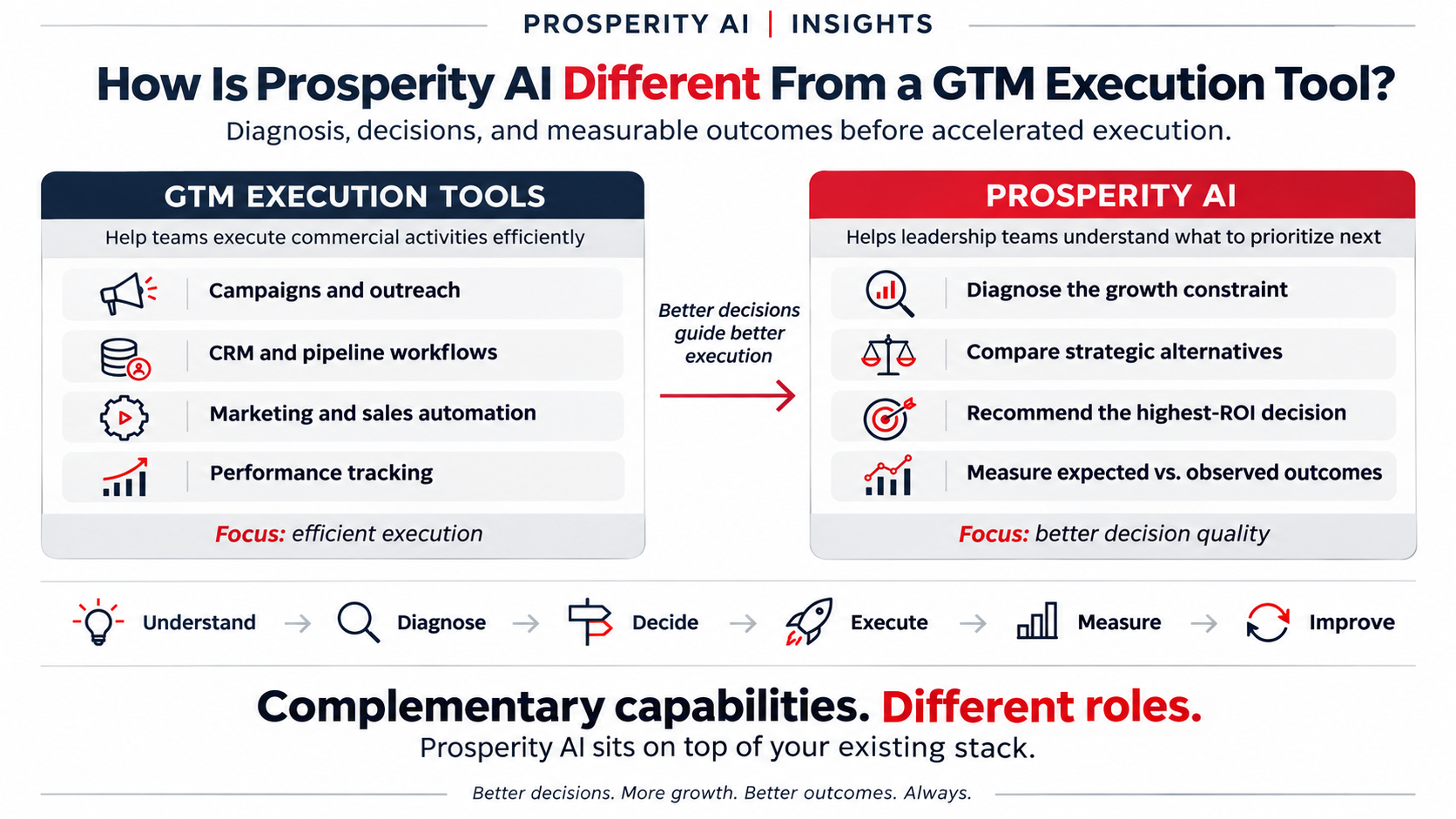
How Is Prosperity AI Different From a GTM Execution Tool?
Why better business growth requires more than faster execution - and how diagnosis, decision intelligence, and measurable outcomes work together.
By Pierluigi Merico | Founder & CEO, Prosperity AI Inc.
November 2, 2026
Execution Is Becoming Easier. Deciding What to Execute Is Not.
Artificial intelligence is transforming go-to-market execution.
Companies can automate outreach, create marketing campaigns, manage sales workflows, analyze customer interactions, and accelerate lead generation.
These capabilities can improve productivity.
But one fundamental question remains:
Are we executing the right strategy?
A company can increase marketing activity, generate more leads, and expand its sales operations without addressing the constraint preventing sustainable growth.
This is where Prosperity AI introduces a different approach.
GTM execution tools help companies carry out commercial activities. Prosperity AI focuses on identifying growth constraints, prioritizing strategic decisions, and connecting those decisions to measurable outcomes.
These capabilities are complementary, not mutually exclusive.
1. GTM Execution vs. AI Growth Intelligence
GTM execution tools commonly support activities such as:
* Marketing campaign management.
* Lead generation and sales outreach.
* CRM and pipeline automation.
* Customer engagement.
* Sales workflow optimization.
* Conversion and performance tracking.
These functions are essential components of a modern commercial organization.
Prosperity AI addresses another part of the process.
Its AI Growth Intelligence framework examines business context across strategic dimensions, including ICP, positioning, pricing, GTM Readiness, retention, and scalability.
The objective is to answer:
What is our primary growth constraint, and which decision should we prioritize next?
A GTM tool may help a team execute a campaign more efficiently.
Prosperity AI helps the leadership team assess whether launching that campaign is the right priority.
2. Example One: More Leads or Better Conversion?
Consider a hypothetical B2B SaaS company experiencing slower revenue growth.
Its management team is considering increasing its marketing budget.
Diagnosis
The company reports:
* Increasing acquisition costs.
* Declining trial-to-paid conversion.
* Growing website traffic.
* Weak customer activation.
The primary constraint may not be insufficient demand.
It may be the inability to convert existing demand into paying customers.
Strategic Decision
Instead of immediately increasing acquisition spending, management could prioritize improving onboarding and activation.
An execution tool could then support the necessary customer journeys, experiments, and workflow automation.
Verified Outcome
Before implementation, the team defines a measurable target.
For example:
Expected Outcome: Increase trial-to-paid conversion from 12% to 18% within 90 days.
Measurement Date: Day 90.
Observed Outcome: To be measured against the actual conversion data.
The decision should be evaluated through comparable customer cohorts, implementation costs, and the resulting financial contribution.
The 12% and 18% figures are illustrative targets, not verified Prosperity AI customer results.
The value of intelligence is not merely recommending an action. It is establishing what evidence would demonstrate that the action created value.
3. Example Two: Broad ICP or Repeatable Growth?
Prosperity AI’s B2B SaaS Growth Intelligence Report 2026 - Second Edition analyzed 100 companies in the San Francisco Bay Area using publicly available information.
The research identified recurring challenges involving ICP clarity, economic-buyer alignment, positioning, and GTM repeatability.
Reviews of companies including Clidey/WhoDB and Assemble illustrated the strategic risks associated with broad customer targeting.
Diagnosis
When a company addresses multiple customer segments, industries, and use cases simultaneously, its commercial evidence may become fragmented.
This can make positioning, channel performance, and acquisition economics difficult to validate.
Strategic Decision
A potential recommendation is to select one priority customer segment and validate a repeatable commercial motion before expanding.
Outcome Validation
The company would need to measure:
* Qualified conversion by customer segment.
* Sales-cycle duration.
* Customer acquisition costs.
* Activation and retention.
* Revenue and contribution margin by segment.
The published Business Reviews identify strategic hypotheses from public evidence.
They do not establish that these specific companies implemented the recommendations or achieved subsequent financial improvements.
That distinction is essential.
A strategic assessment becomes stronger when the company validates the diagnosis and measures the outcome of the selected decision.
4. Why Decision Sequencing Matters
Imagine two companies using the same GTM automation platform.
Company A increases outreach across multiple market segments without a validated ICP.
Company B first identifies its most promising customer segment, validates its positioning, and then uses automation to scale a focused acquisition process.
Both companies may benefit from the technology.
But their outcomes will depend on the quality of their assumptions, execution, market conditions, and commercial economics.
This illustrates the Prosperity AI principle:
Growth is a sequencing problem before it becomes a scaling problem.
The appropriate sequence is:
UNDERSTAND → DIAGNOSE → COMPARE → DECIDE → EXECUTE → MEASURE → IMPROVE
Execution is fundamental.
But execution becomes more accountable when connected to a clearly defined decision and a measurable expected outcome.
5. How Prosperity AI Complements Existing GTM Tools
Prosperity AI is designed to sit on top of a company’s existing software stack.
It does not require businesses to abandon their CRM, analytics, marketing, billing, or sales tools.
Instead, it provides a strategic intelligence layer designed to support decisions across the business.
The system includes:
Free Discover
An initial assessment of the primary growth constraint, three strategic weaknesses, GTM Readiness, and a recommended highest-ROI decision.
Business Snapshot
An assessment of five strategic dimensions, establishing an initial understanding of the business.
Full Business Review + Executive Plan
A deeper review across 27 strategic dimensions, connected to prioritized execution recommendations.
Monday Morning Executive Brief
A recurring framework for reviewing what changed, what matters, what should wait, and which decision deserves attention next.
Decision Measurement
A framework that connects Expected Outcome, Measurement Date, Observed Outcome, and Decision Success Score.
The last stage is especially important.
It creates the foundation for learning whether strategic decisions generated their intended results.
6. From Recommendations to Verified Economic Outcomes
An effective decision intelligence system must distinguish between three levels of evidence.
Level 1 - Strategic Diagnosis
What the available business information suggests about the company’s growth constraints.
Level 2 - Decision Validation
Whether the proposed intervention is supported by customer, operational, commercial, or financial evidence.
Level 3 - Outcome Verification
Whether the implemented decision generated the expected measurable improvement.
For example, reducing acquisition costs is not automatically a successful outcome if customer quality or retention deteriorates.
Similarly, improving conversion does not guarantee a positive return if implementation costs exceed the incremental economic benefit.
Reliable outcome verification requires internal company data, suitable comparison periods, and consideration of other factors affecting performance.
This is why Prosperity AI’s long-term vision extends beyond generating Business Reviews.
The objective is to develop an intelligence system that learns which decisions produce better outcomes, for which businesses, and under which conditions.
This capability depends on accumulating validated decision and outcome evidence over time.
7. Better Decisions and Better Execution Belong Together
GTM execution tools and AI Growth Intelligence solve different but connected problems.
Execution tools help organizations implement commercial activities.
Decision Intelligence helps leadership teams evaluate priorities, compare alternatives, and define what success should look like.
Neither function guarantees business growth.
Their potential value increases when companies combine strategic clarity with disciplined execution and reliable outcome measurement.
The question is not whether businesses need GTM execution tools.
The question is whether they know which decisions those tools should execute first.
That is the problem Prosperity AI is designed to address.
Discover Your Next Growth Decision
Before launching another campaign, expanding your sales team, or increasing acquisition spending, identify the constraint that matters most.
Start with Prosperity AI Free Discover to explore your primary growth constraint, GTM Readiness, and highest-ROI decision.
Start Free Discover
For deeper strategic analysis, explore the Full Business Review + Executive Plan.
Explore Prosperity AI
Better decisions. More growth. Better outcomes. Always.
⸻
Methodology and Transparency
This article distinguishes product capabilities, publicly sourced strategic assessments, hypothetical decision examples, and verified business out
Methodology: This insight applies Prosperity AI’s Growth Intelligence framework to the evidence and context available for the review. Conclusions should be read with the linked evidence and validated against current business data.