Prosperity AI · Insight
AI Decision Intelligence vs. Business Intelligence: What's the Difference?
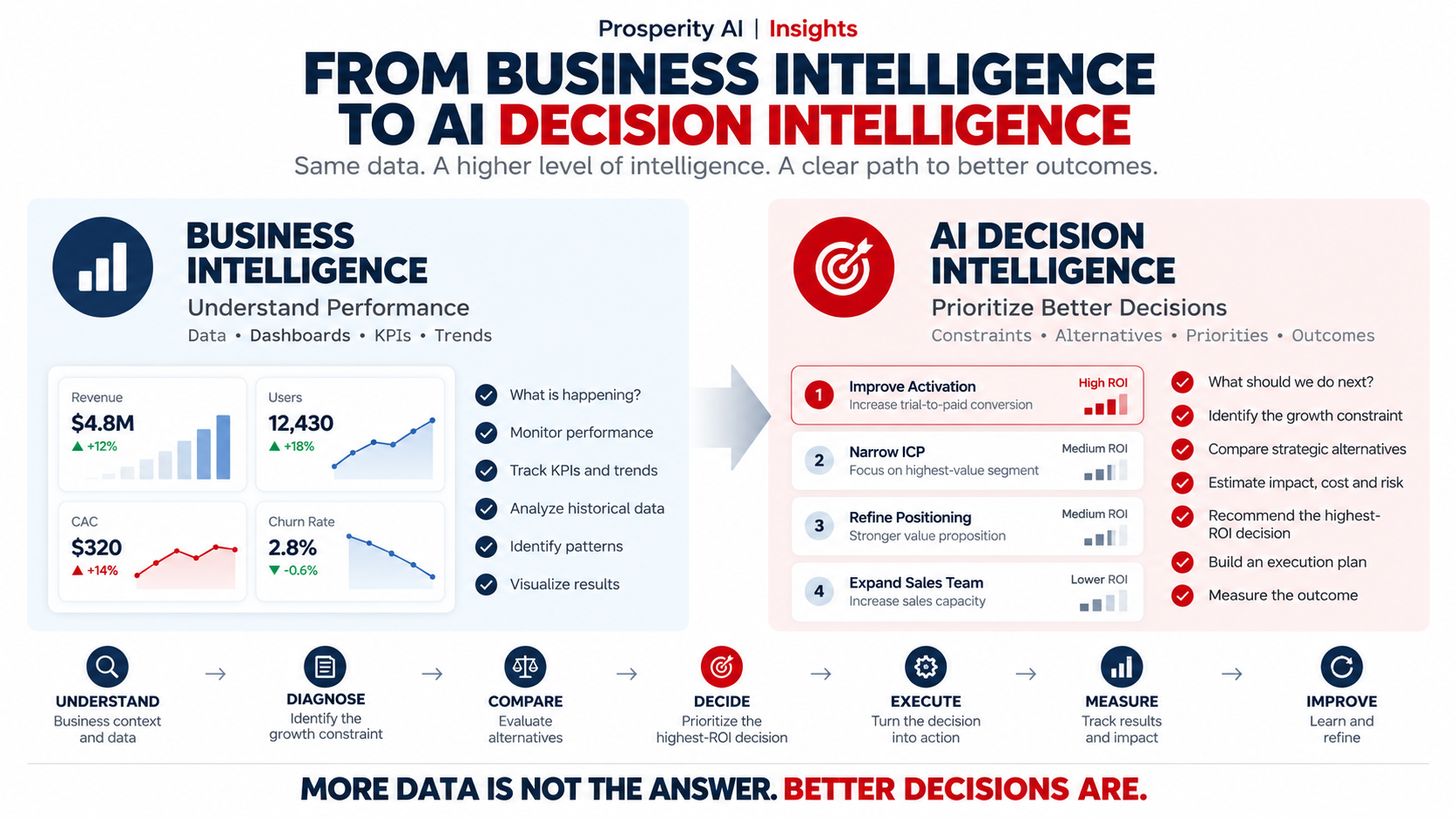
AI Decision Intelligence vs. Business Intelligence: What’s the Difference?
Why understanding business performance is no longer enough, and why the next competitive advantage is knowing what to do about it.
By Pierluigi Merico | Founder & CEO
Prosperity AI Inc.
October 23, 2026
More Data Doesn’t Automatically Mean Better Decisions
Businesses have never had access to more information.
Dashboards track revenue, customer acquisition, profitability, retention, sales performance, and operational efficiency.
Artificial intelligence is making this information faster and easier to analyze.
Yet one fundamental challenge remains:
Knowing what is happening in your business is not the same as knowing what you should do next.
This is where the distinction between Business Intelligence and AI Decision Intelligence becomes important.
1. What Is Business Intelligence?
Business Intelligence (BI) helps organizations collect, organize, analyze, and visualize business information.
Platforms such as Power BI, Tableau, and other analytics systems allow management teams to monitor performance and identify relevant patterns.
BI helps answer questions such as:
* How much revenue did we generate?
* Which acquisition channels are performing?
* Why are margins declining?
* How is customer retention changing?
* Where are we missing our targets?
These insights are essential.
But identifying a performance problem does not automatically establish which strategic intervention will create the greatest value.
Business Intelligence makes performance visible.
2. What Is AI Decision Intelligence?
AI Decision Intelligence combines business evidence, strategic context, analytics, and AI-assisted reasoning to support decisions.
Instead of focusing primarily on reports and indicators, it starts with the decision itself.
The questions become:
* What is currently limiting business growth?
* Which strategic alternatives are available?
* What are the expected benefits, costs, and risks?
* Which decision deserves priority?
* How will we measure whether the decision worked?
Decision Intelligence does not replace Business Intelligence.
It builds on relevant information to help leadership teams move from analysis to prioritized action.
AI Decision Intelligence connects business understanding to strategic choices and measurable outcomes.
3. From Dashboards to Decisions
Consider a B2B SaaS company experiencing slower revenue growth.
Its Business Intelligence dashboard reveals three signals:
* Customer acquisition costs are increasing.
* Trial conversion rates are declining.
* Marketing spending continues to rise.
The data reveals a problem.
But management still needs to determine what to do.
Should the company increase marketing investment?
Hire additional salespeople?
Improve product activation?
Narrow its Ideal Customer Profile?
Reposition its value proposition?
Each option has different costs, risks, and potential returns.
An AI Decision Intelligence approach evaluates these alternatives against the company’s current growth constraint and available evidence.
For example, if the primary issue is low activation among newly acquired users, increasing acquisition spending may amplify inefficiency.
Improving activation could become the more valuable priority.
The objective is not simply to optimize a metric. It is to identify the decision most likely to improve the economic outcome.
4. The Difference in One Framework
Business Intelligence AI Decision Intelligence
What is happening? What should we do next?
Performance dashboards Strategic decision comparison
KPIs and trends Constraints and priorities
Historical and current data Business context and alternative actions
Performance analysis Decision support and execution planning
Monitoring results Evaluating decisions against results
These capabilities are complementary.
Modern BI platforms can also incorporate predictive analytics and recommendations. The distinction is therefore one of primary emphasis, not an absolute technological boundary.
The greatest opportunity is connecting reliable business data with structured decision-making.
5. Why Growth Constraints Matter
Not every problem deserves equal attention.
A company may have weaknesses in marketing, sales, pricing, customer retention, and operations simultaneously.
But addressing all of them at once can fragment resources.
At Prosperity AI, we focus on identifying the primary growth constraint: the issue currently limiting the company’s ability to generate stronger results.
Once the constraint is understood, management can compare alternative decisions and prioritize the intervention with the greatest potential economic impact.
This creates a more disciplined sequence:
UNDERSTAND → DIAGNOSE → COMPARE → DECIDE → EXECUTE → MEASURE → IMPROVE
The objective is to avoid confusing more activity with better performance.
6. Where Prosperity AI Fits
Prosperity AI is building an AI Growth Intelligence System designed to support founders and CEOs throughout the strategic decision cycle.
Rather than replacing existing business software, Prosperity AI is designed to complement the company’s information and management processes.
Through its strategic assessment framework, businesses can:
Free Discover
Identify an initial growth constraint, three strategic weaknesses, GTM Readiness, and a recommended highest-ROI decision.
Business Snapshot
Develop an initial understanding of the business across five strategic dimensions.
Full Business Review + Executive Plan
Expand the analysis across 27 strategic dimensions and develop a prioritized 90-day execution plan.
Continuous Alignment
Revisit strategic assumptions, priorities, and outcomes as new evidence becomes available.
The goal is not another dashboard.
It is a continuous system that connects business understanding, strategic decisions, execution planning, and measurable improvement.
7. The Next Competitive Advantage Is Decision Quality
AI is making execution faster and cheaper.
Companies can produce more content, automate processes, analyze information, and develop products with fewer resources.
But this also makes it easier to execute the wrong strategy faster.
The competitive advantage increasingly depends on knowing:
What matters most?
Which decision should come first?
What should wait?
How will we know whether the decision worked?
Business Intelligence remains essential for understanding performance.
AI Decision Intelligence adds a structured approach to selecting and evaluating actions.
And AI Growth Intelligence applies these capabilities to the challenge of building a stronger, more sustainable business.
The Future Is Not More Dashboards. It’s Better Decisions.
The next evolution of business intelligence is not simply collecting more data or generating more sophisticated visualizations.
It is connecting evidence to decisions and decisions to outcomes.
Metrics reveal what is happening.
Intelligence helps explain why.
Better decisions determine what happens next.
That is the future we are building at Prosperity AI.
Discover Your Next Growth Decision
Start with Prosperity AI Free Discover to identify your primary growth constraint, GTM Readiness, and highest-ROI decision.
For deeper strategic intelligence, explore the Full Business Review + Executive Plan, covering 27 strategic dimensions and a prioritized 90-day execution roadmap.
Explore Prosperity AI
Better decisions. More growth. Better outcomes. Always.
⸻
Methodology & Transparency
AI Decision Intelligence is a decision-support approach, not a guarantee that AI-generated recommendations will produce superior business outcomes.
Decision quality depends on the reliability of business data, the validity of assumptions, appropriate human judgment, and measurement of observed results.
When Prosperity AI assessments rely on publicly available information, internal operational, financial, and customer evidence may materially change the conclusions.
Strategic recommendations should be reviewed and validated before implementation.
Methodology: This insight applies Prosperity AI’s Growth Intelligence framework to the evidence and context available for the review. Conclusions should be read with the linked evidence and validated against current business data.