Prosperity AI · Insight
The Commoditization of Execution and the Rise of Growth Intelligence
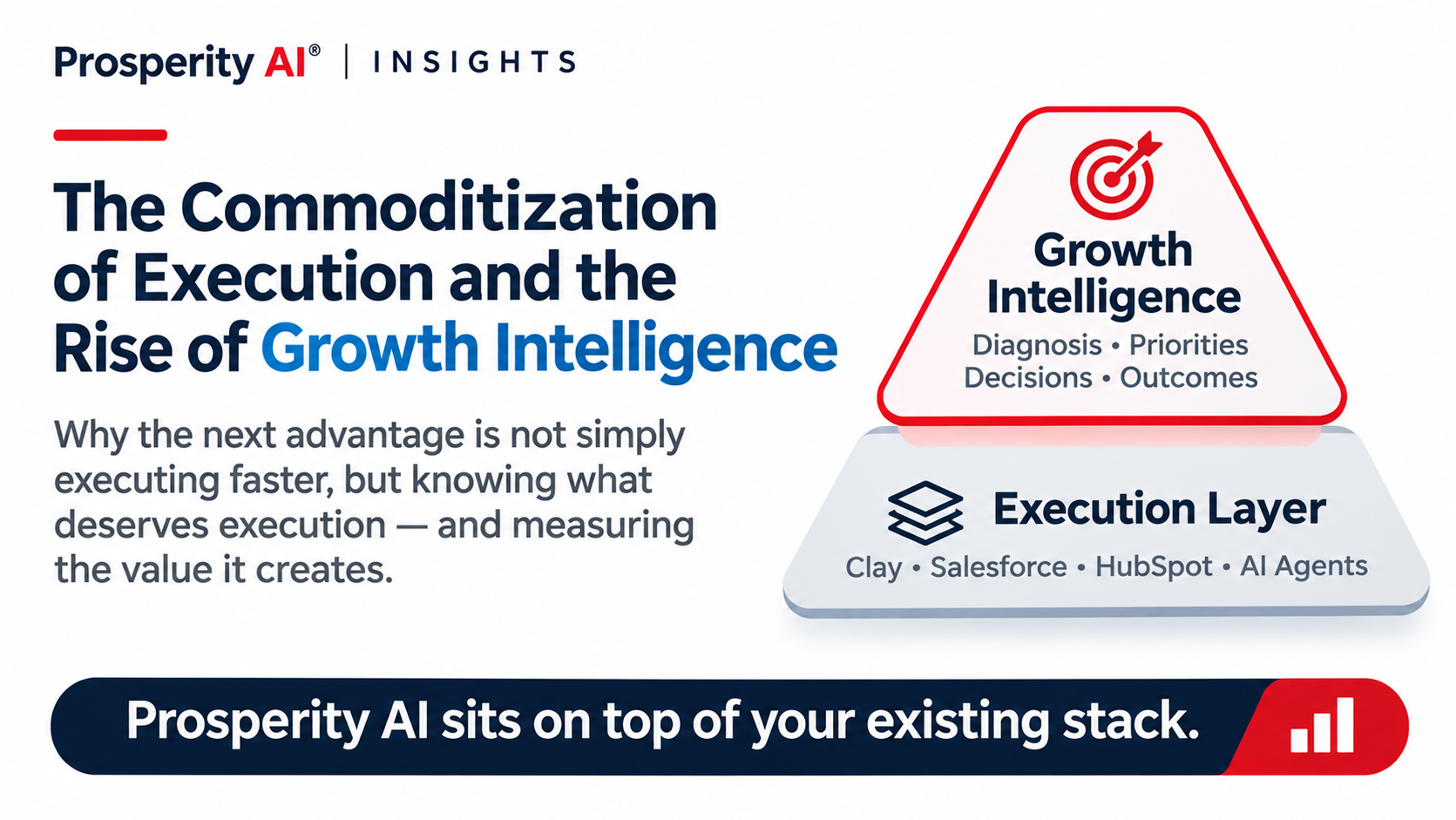
The Commoditization of Execution and the Rise of Growth Intelligence
Why the next competitive advantage in B2B SaaS is not simply executing faster, but knowing what deserves execution — and measuring the economic value it creates.
By Pierluigi Merico | Founder & CEO, Prosperity AI Inc. | November 27, 2026
The Next AI Revolution Is About Decisions
Artificial intelligence is rapidly changing how businesses execute.
Sales teams can automate prospecting, research, outreach, and follow-up. Marketing teams can launch campaigns faster. Product teams can develop software with fewer resources. AI agents can coordinate increasingly complex workflows.
Companies such as Clay, Salesforce, and HubSpot are expanding these capabilities.
But an important question remains:
When execution becomes faster, cheaper, and more accessible, who decides what deserves execution?
A B2B SaaS company can generate more leads, build more features, and automate more workflows without resolving the constraint preventing sustainable growth.
This is the strategic opportunity behind Growth Intelligence.
AI makes execution faster. Growth Intelligence helps founders decide what deserves execution.
1. Execution Is Becoming More Accessible
For decades, companies competed partly on their ability to execute complex activities efficiently.
Building software required specialized teams. Running sophisticated acquisition campaigns demanded significant resources. Sales organizations depended on manual research, qualification, and follow-up.
AI is changing those economics.
Clay provides infrastructure for GTM data, account research, enrichment, and automated workflows. Its expanding orchestration capabilities help teams coordinate increasingly sophisticated commercial activities.
Salesforce is integrating AI agents into sales, service, and enterprise workflows through Agentforce and its broader platform.
HubSpot is evolving its customer platform through AI agents, customer context, and intelligent commercial workflows.
These companies are not simply automating individual tasks. They are also developing capabilities for recommendations, coordination, and continuous optimization.
The important trend is broader than any individual vendor.
As execution capabilities become more widely available, access to automation alone becomes a less distinctive source of competitive advantage.
This does not mean execution loses value. Reliable execution, integration, proprietary data, and customer relationships can remain highly defensible.
It means founders must become more precise about where execution creates economic value.
2. The Hidden Risk: Executing the Wrong Strategy Faster
Consider a hypothetical B2B SaaS company experiencing slower revenue growth.
Management decides to increase outbound activity.
With modern AI tools, the company can identify more accounts, personalize outreach, automate follow-up, and generate additional meetings.
But what if the real growth constraint is not pipeline volume?
It may be:
* An insufficiently validated Ideal Customer Profile.
* Weak economic-buyer alignment.
* Poor trial-to-paid conversion.
* Unclear product differentiation.
* High churn or unfavorable unit economics.
Increasing outbound activity may improve productivity without resolving the underlying problem.
The company becomes better at executing a strategy that may not deserve additional investment.
Automation improves execution capacity. It does not automatically validate strategic priorities.
The right decision depends on diagnosing the constraint and evaluating the available evidence.
3. From Execution Intelligence to Growth Intelligence
Execution Intelligence focuses on performing, coordinating, and optimizing business activities.
Growth Intelligence addresses a complementary question:
Which strategic intervention should the company prioritize to improve sustainable economic performance?
This requires understanding more than a single workflow.
A business may have an efficient CRM and an underperforming acquisition model. It may possess excellent AI capabilities but unclear customer positioning. It may generate strong revenue growth while facing deteriorating contribution margins.
A Growth Intelligence approach connects five questions:
What is changing? Understand relevant developments in the market, business, customers, and competitive environment.
What is constraining growth? Identify the potential limitation currently reducing business performance.
What evidence supports the diagnosis? Distinguish strategic hypotheses from validated operational findings.
Which decision deserves priority? Compare alternatives based on expected value, cost, risk, feasibility, and timing.
Did the decision work? Evaluate expected outcomes against observed results and learn from the difference.
The continuous process is:
IDENTIFY → VALIDATE → PRIORITIZE → EXECUTE → MEASURE → IMPROVE
The objective is not to replace existing execution systems.
It is to strengthen the strategic decisions that guide their use.
4. What Our B2B SaaS Research Suggests
Prosperity AI’s research program has reached 148 public strategic analyses, primarily focused on B2B SaaS companies in the San Francisco Bay Area.
Our published research covering the first 100 reviews identified recurring questions around ICP clarity, positioning, economic-buyer alignment, GTM repeatability, and decision sequencing.
These observations reinforce an important distinction:
Technical capability does not automatically create commercial repeatability.
A company can build an advanced product without establishing which customers generate the greatest economic value.
It can automate acquisition without validating buyer urgency.
It can expand distribution before demonstrating sustainable unit economics.
These are potential strategic constraints identified through public evidence, not verified conclusions about internal company performance.
Their value lies in identifying which assumptions deserve further investigation.
Growth is a sequencing problem before it becomes a scaling problem.
5. Prosperity AI Sits on Top of Your Existing Stack
Prosperity AI is building an AI Growth Intelligence System designed to complement the software businesses already use.
The objective is not to replace Clay, Salesforce, HubSpot, analytics platforms, or specialized AI agents.
It is to help leadership teams understand when, why, and toward which measurable objective those tools should be deployed.
Our system connects four complementary services.
Free Discover — Identify the Constraint
An initial assessment of the potential #1 Growth Constraint, three strategic weaknesses, GTM Readiness, and a recommended highest-ROI decision.
Business Snapshot — Understand the Business
A structured assessment across five foundational business dimensions, establishing the context required for deeper strategic analysis.
Full Business Review + Executive Plan — Prioritize Action
An assessment across 27 strategic dimensions, connected to prioritized decisions and a focused 90-day Executive Plan.
Monday Morning Executive Brief — Review and Realign
A recurring framework for understanding what changed, reassessing priorities, reviewing previous decisions, and evaluating available outcome evidence.
Together, these capabilities are intended to connect business understanding, strategic decisions, execution planning, and continuous learning.
Prosperity AI sits on top of your existing stack.
This is a strategic product positioning, not a claim that every third-party platform is already technically integrated.
6. A Practical Example: When Should a Founder Use Clay?
Imagine a B2B SaaS company considering a new outbound campaign.
Clay may help the company identify accounts, enrich customer data, construct targeting workflows, and execute personalized GTM activities.
But before increasing that investment, the founder should ask:
Is insufficient qualified pipeline really our primary growth constraint?
Is the ICP validated?
Are conversion and retention sufficiently strong?
Will additional acquisition generate attractive economic returns?
If the evidence points toward insufficient qualified pipeline, expanding outbound execution may be justified.
If the primary constraint is poor activation or unclear positioning, the higher-value decision may be different.
The objective is not deciding whether Clay is a good tool. It is deciding whether expanding outbound is the right strategic priority now.
The same principle applies to Salesforce, HubSpot, and other AI-powered execution platforms.
7. From More Automation to Measurable Economic Outcomes
AI is making it possible to execute more initiatives with less friction.
But the number of campaigns launched, messages sent, features released, or workflows automated does not independently establish economic value.
Founders need to connect execution with measurable outcomes.
A decision to improve activation should be evaluated through relevant usage, conversion, retention, and economic indicators.
A decision to expand outbound should be assessed through qualified opportunities, conversion, customer acquisition costs, and revenue contribution.
A pricing decision should be evaluated against willingness to pay, retention, margin, and customer value.
Prosperity AI’s Decision Measurement approach connects:
EXPECTED OUTCOME → MEASUREMENT DATE → OBSERVED OUTCOME → DECISION SUCCESS ASSESSMENT
Reliable verification requires internal data, documented implementation, and appropriate consideration of external factors.
The long-term competitive opportunity is not simply generating better recommendations. It is learning which decisions produce better outcomes, for which businesses, and under which conditions.
8. Frequently Asked Questions
Is Prosperity AI a competitor to Clay, Salesforce, or HubSpot?
These platforms have overlapping areas of decision support, but different primary product focuses. Prosperity AI is designed around cross-functional growth diagnosis, strategic prioritization, and decision-outcome learning. The tools may be complementary, although some capabilities can overlap.
Does Prosperity AI replace GTM execution tools?
No. Prosperity AI is designed to support strategic decisions while existing tools and specialist teams execute commercial activities. It is not positioned as a replacement for an entire CRM, marketing, or sales execution platform.
What is the difference between Growth Intelligence and business analytics?
Business analytics helps explain performance through data and metrics. Growth Intelligence seeks to connect business evidence with constraints, strategic alternatives, prioritized decisions, and measurable outcomes. Modern analytics platforms may also provide some decision-support capabilities.
Can AI identify a company’s primary growth constraint automatically?
AI can identify potential constraints based on available information. Confirming their importance requires sufficient customer, commercial, operational, or financial evidence.
Why does decision quality matter more as execution becomes cheaper?
Because organizations can pursue more initiatives while capital, management attention, and customer demand remain limited. Better prioritization helps determine where additional execution is most likely to create economic value.
How does Prosperity AI support measurable growth?
Its framework connects business assessments, decision priorities, executive planning, and outcome review. Actual financial improvements depend on implementation, validation, and reliable measurement.
Conclusion — The Next Advantage Is Knowing What to Execute
The commoditization of execution does not mean every workflow will become interchangeable or every software company will lose its competitive advantage.
It means AI is changing where strategic differentiation can emerge.
Access to automation is increasingly widespread.
But understanding customer value, validating growth constraints, allocating resources intelligently, and demonstrating economic outcomes remain difficult.
The next generation of successful B2B SaaS companies may not be those that automate the greatest number of activities.
They may be those that consistently identify which activities deserve execution and prove that their decisions create value.
That is the future of AI Growth Intelligence we are building at Prosperity AI.
Discover Your Next Growth Decision
Before investing in another AI tool, automation workflow, or acquisition campaign, investigate what may actually be limiting growth.
START FREE DISCOVER
Better decisions. More growth. Better outcomes. Always.
Research & Methodology
This article presents an independent strategic interpretation of developments in AI-enabled business execution. The examples are hypothetical and do not represent verified customer results.
Prosperity AI’s public B2B SaaS assessments identify strategic hypotheses, not audited internal constraints. The published first-100 research supports qualitative patterns; it does not establish a statistically validated ranking across all 148 reviewed companies.
Vendor capabilities evolve and may overlap with Growth Intelligence. No exclusive functional distinction or live third-party integration is implied.
Sources: Clay — Introducing Workflows and Clay’s Product Roadmap (2026); Salesforce — Agentforce Sales and Agentforce AI Agents (2026); HubSpot — Fall 2026 Spotlight and Introducing the Agentic Customer Platform; Prosperity AI — B2B SaaS Growth Intelligence Report 2026, Second Edition.
Methodology: This insight applies Prosperity AI’s Growth Intelligence framework to the evidence and context available for the review. Conclusions should be read with the linked evidence and validated against current business data.