Prosperity AI · Insight
Product-Market Fit vs. GTM Readiness: What Founders Need to Know
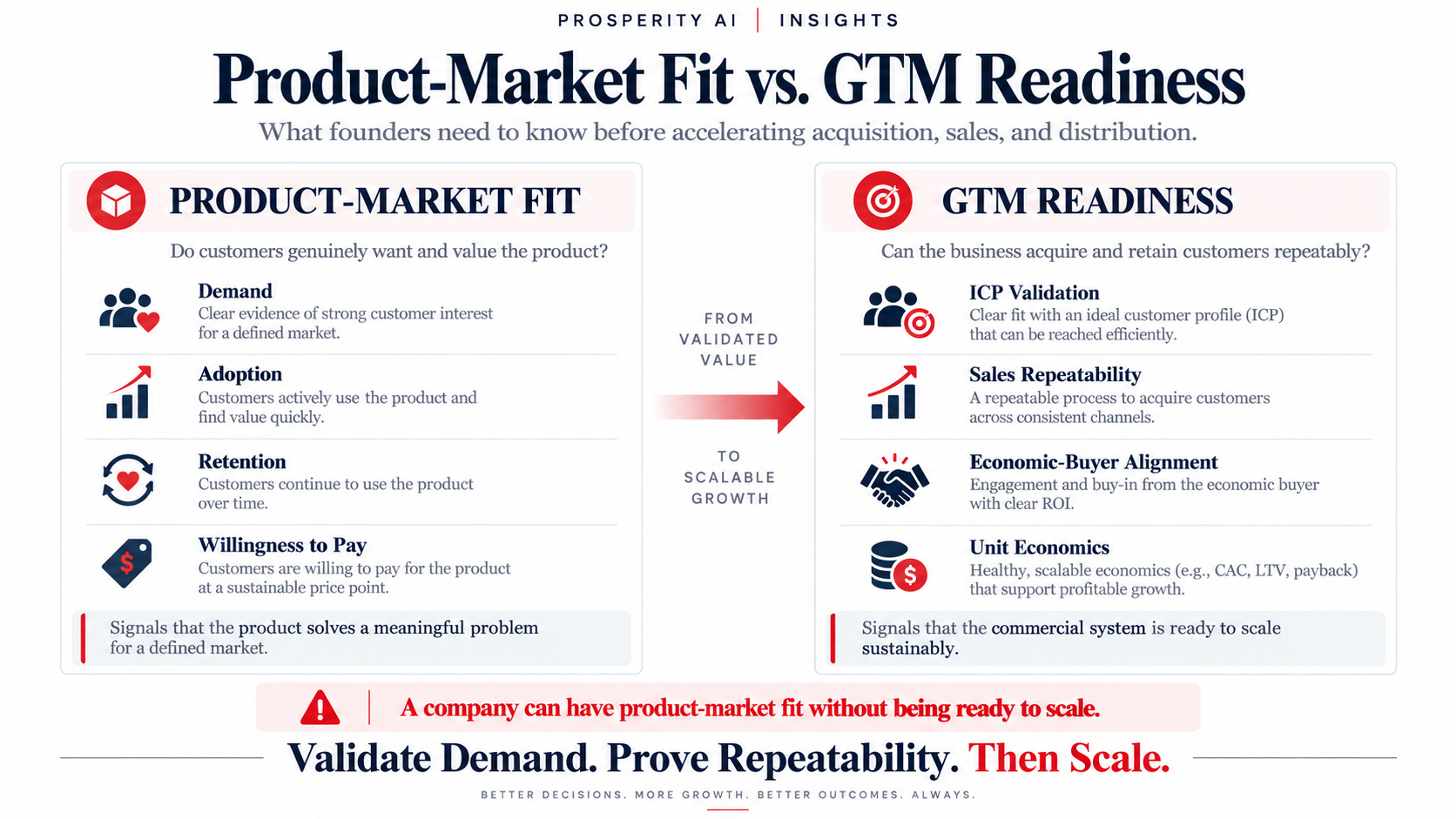
Product-Market Fit vs. GTM Readiness: What Founders Need to Know
Having a product customers love does not automatically mean your business is ready to scale.
By Prosperity AI Research Team
October 22, 2026
A Great Product Is Not Yet a Scalable Business
Many founders believe that once customers adopt their product, the next step is to accelerate growth.
Increase marketing budgets. Hire more salespeople. Expand distribution. Enter new markets.
But there is a critical distinction between Product-Market Fit (PMF) and Go-to-Market Readiness (GTM Readiness).
A company can demonstrate meaningful product demand without having a repeatable, economically sustainable customer acquisition system.
Understanding this difference can prevent expensive scaling mistakes.
Product-Market Fit validates customer demand. GTM Readiness evaluates whether the business is prepared to scale that demand.
1. What Is Product-Market Fit?
Product-Market Fit exists when a product satisfies a meaningful market need and customers consistently demonstrate that the solution creates value.
Evidence may include:
* Strong product adoption and activation.
* Consistent customer engagement.
* Retention and repeat usage.
* Willingness to pay.
* Customer referrals and organic demand.
The essential question is:
Have we built something customers genuinely want and continue to value?
However, early customer enthusiasm does not automatically establish a scalable commercial model.
2. What Is GTM Readiness?
GTM Readiness evaluates whether a company has the commercial foundations required to acquire, convert, and retain customers through a repeatable process.
It examines several strategic dimensions:
ICP Validation: Is the ideal customer segment clearly identified?
Economic-Buyer Alignment: Does the person controlling the budget understand the business value?
Positioning: Is the value proposition differentiated and compelling?
Sales Repeatability: Can the company reproduce successful customer acquisition?
Unit Economics: Are acquisition costs, pricing, and customer value economically sustainable?
Distribution: Can marketing, sales, and partnerships generate predictable demand?
The fundamental question becomes:
Can we repeatedly acquire and retain the right customers at attractive economics?
3. What 100 B2B SaaS Reviews Revealed
Prosperity AI’s B2B SaaS Growth Intelligence Report 2026 — Second Edition examined 100 public strategic analyses of companies in the San Francisco Bay Area.
The findings highlighted recurring challenges involving:
* Broad or insufficiently validated customer profiles.
* Technical adoption without clear economic-buyer alignment.
* Weak commercial differentiation.
* Limited visibility into sales conversion.
* Unproven acquisition repeatability.
Companies such as Chroma, Momentic, Nango, and Browserbase illustrated different versions of these strategic challenges.
The important distinction is that these were external assessments based on public information, not definitive evaluations of the companies’ internal performance.
Nevertheless, the recurring pattern reinforces an important lesson:
Technical credibility and early traction do not automatically establish GTM Readiness.
4. When Should Founders Accelerate Growth?
Before materially increasing acquisition spending or sales capacity, founders should look for evidence across three areas.
Customer Value
Customers consistently activate, use, and retain the product.
Commercial Repeatability
The company can identify qualified customers, convert them through a consistent process, and understand its sales performance.
Economic Sustainability
Pricing, customer acquisition costs, retention, and customer value support a credible growth model.
When these elements remain uncertain, the priority should often be validation rather than acceleration.
When they are supported by sufficient evidence, increasing investment becomes a more informed decision.
Scaling should follow validated evidence, not simply early enthusiasm.
5. The Right Decision Depends on the Growth Constraint
Not every company needs more marketing, more features, or a larger sales team.
One business may need to improve customer retention.
Another may need to narrow its ICP.
A third may need stronger positioning or clearer economic-buyer alignment.
This is why Prosperity AI focuses on identifying the primary growth constraint before recommending the next strategic action.
The process follows a disciplined sequence:
NARROW → VALIDATE → DIFFERENTIATE → PROVE → REPEAT → SCALE
The objective is not to delay growth unnecessarily.
It is to allocate resources where they can create the greatest economic value.
6. How AI Growth Intelligence Supports Better Scaling Decisions
Artificial intelligence is making business execution faster and more affordable.
But increased execution capacity does not eliminate strategic uncertainty.
At Prosperity AI, our AI Growth Intelligence System is designed to help founders and CEOs understand their business, identify strategic weaknesses, evaluate GTM Readiness, and prioritize their highest-ROI decision.
Through Free Discover, Business Snapshot, and Full Business Review + Executive Plan, companies can move from initial diagnosis toward a structured growth strategy.
The objective is to connect:
BUSINESS UNDERSTANDING → STRATEGIC DECISIONS → EXECUTION → MEASURABLE OUTCOMES
Because the challenge is not simply deciding how to grow.
It is knowing when the business is ready to scale — and what must be validated first.
The Bottom Line
Product-Market Fit and GTM Readiness are connected, but they are not interchangeable.
A valuable product creates demand.
A repeatable go-to-market system helps convert demand into sustainable business growth.
And better strategic intelligence helps founders understand which decision should come next.
Product-Market Fit proves value. GTM Readiness supports scalable execution. Growth Intelligence connects both to better decisions.
Discover Your GTM Readiness
Before investing more in customer acquisition, sales, or distribution, identify what is currently limiting your growth.
Start with Prosperity AI Free Discover to assess your growth constraints, strategic weaknesses, GTM Readiness, and highest-ROI decision.
Explore Prosperity AI
Better decisions. More growth. Better outcomes. Always.
⸻
Research note: The Prosperity AI B2B SaaS Growth Intelligence Report 2026 - Second Edition synthesizes 100 publicly sourced strategic assessments. These assessments are not audited company performance evaluations. Commercial readiness and scaling decisions require validation with internal customer, sales, and financial data.
Methodology: This insight applies Prosperity AI’s Growth Intelligence framework to the evidence and context available for the review. Conclusions should be read with the linked evidence and validated against current business data.